Key Takeaways: How to Avoid Getting Ripped Off
Key Takeaways – Protecting Yourself When Hiring a Roofer
- Always verify license and insurance—and get the certificates, not just verbal assurances.
- Compare quotes by scope, not just price: tear‑off, underlayment, flashing, ventilation, decking, cleanup, and warranties.
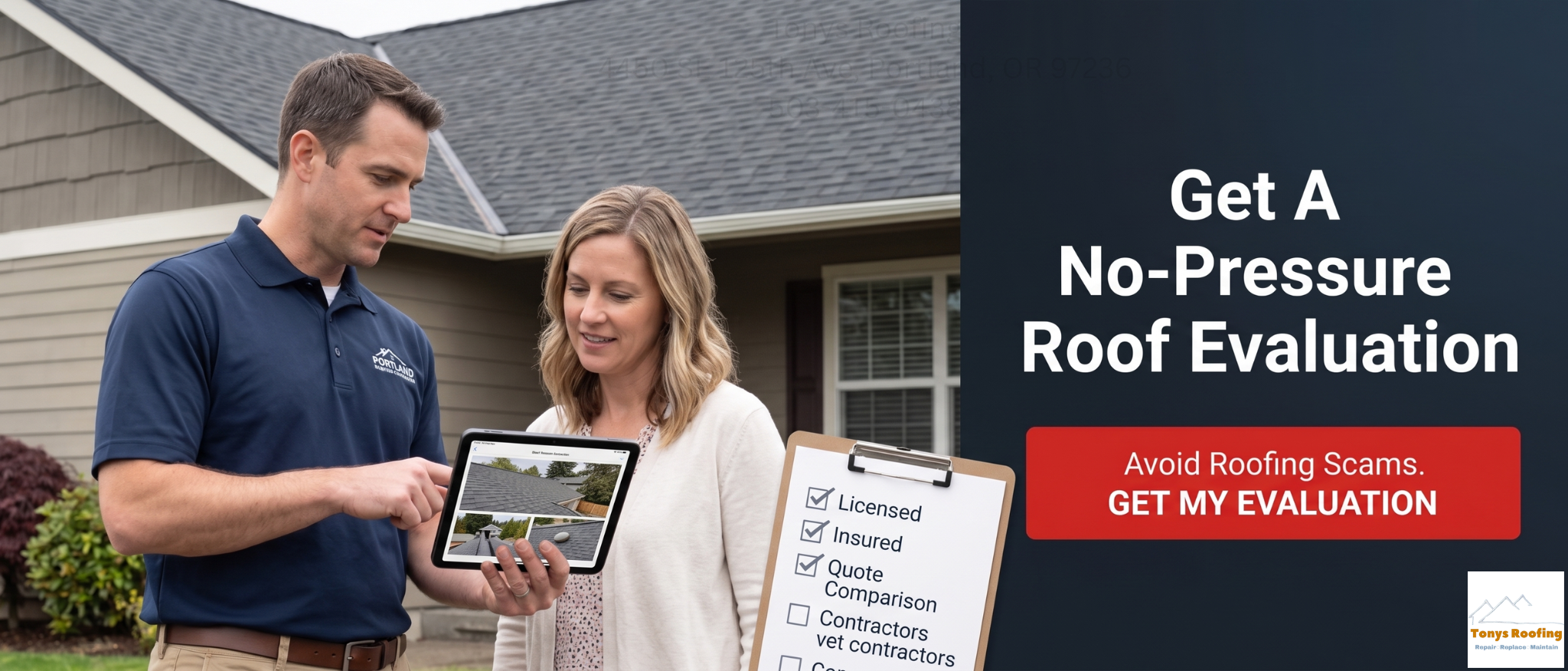
- A trustworthy roofer explains flashing, ventilation, and warranties clearly and shows you photos of what they see.
- Walk away from pressure tactics, vague proposals, and too‑good‑to‑be‑true prices that don’t make sense.
- The safest next step is a photo‑documented inspection and written scope—and if a repair is enough, the right contractor will tell you.
Roof Work Is Stressful. Getting Ripped Off Shouldn’t Be Inevitable.
A new roof is one of the biggest checks most Portland homeowners will ever write. You’re staring at thousands (maybe tens of thousands) of dollars, can’t safely climb up to verify the damage, and every contractor seems to say something different.
No wonder your guard is up.
You deserve straight answers, clear numbers, and work that actually protects your home—not pressure tactics or “trust me” guesses.
This guide walks you through:
- Why roofing is such a common place for bad actors
- A 10‑point checklist to vet any contractor
- How to compare quotes apples‑to‑apples
- Red flags and green flags to watch for
- A simple “what to do next” flow if you’re still unsure
Why Roofing Is a Magnet for Scams (Without Fearmongering)
You’re not “paranoid” for feeling cautious. Roofing is uniquely vulnerable:
- Most of the problem is hidden.
Rot, soft decking, bad flashing—these are hard to see from the ground. You’re relying on someone else’s word and photos. - Storms create urgency.
Wind or heavy rain hits, and suddenly you have leaks, tarps, door‑knockers, and “we’re in your area today” pitches. - Quotes vary wildly.
Two bids for the “same” roof can differ by thousands because the scope isn’t actually the same—layers, flashing, ventilation, and warranties can all be different behind the scenes. - High pressure can override your gut.
Some companies lean on fear (“your roof is about to fail”) and “today‑only” discounts to get a signature before you’ve had time to think.
This guide is here to normalize your caution and give you a process so you feel in control—not rushed.
The 10‑Point Roofing Contractor Vetting Checklist
Use these as your non‑negotiables. For each point:
- What to ask
- What a good answer looks like
1. License, Insurance, and Bonding
Ask:
“Can you send me your CCB license number and proof of liability insurance and workers’ comp?”
Good answer:
- Sends documentation without hesitation
- License matches the company name you’re dealing with
- Insurance is current and adequate for roofing work
If they dodge, delay, or get defensive, that’s your cue to walk.
2. Local Address and Longevity
Ask:
“How long have you been roofing in the Portland area, and what’s your local office address?”
Good answer:
- A real, local address (not just a PO box)
- Several years in business under the same name
- Happy to talk about neighborhoods they’ve worked in (SE, Beaverton, Gresham, etc.)
“If you can’t call them in 3 years, their warranty isn’t worth much.”
3. Detailed Scope of Work (Not Just “New Roof”)
Ask:
“Can you walk me through exactly what’s included in your quote?”
Good answer mentions:
- Tear‑off: how many layers, haul‑away and dump fees
- Underlayment: type and where it’s used
- Shingles/materials: exact product line and rating
- Flashing: what’s replaced vs re‑used (chimneys, skylights, walls)
- Ventilation: ridge vents, soffits, other upgrades if needed
- Cleanup: magnet nail sweep, property protection
You want a written scope that reads like a checklist, not a fortune cookie.
4. Photo Documentation of Issues
Ask:
“Can you show me photos of what you’re seeing and explain them?”
Good answer:
- Clear photos of problem areas with simple explanations
- Before/after examples from past jobs
- Willing to email or text images so you can zoom and review
A roofer who won’t show you what they see is asking you to buy blind.
5. Flashing and Ventilation Discussion
Ask:
“What’s your plan for my flashing and ventilation?”
Good answer:
- Talks proactively about:
- Chimney and skylight flashing
- Step flashing at walls
- Pipe boots and valleys
- Explains ventilation options (ridge vents, soffit vents) and why they matter
Pros talk about details; pretenders talk only about shingles and price.
6. Warranty Clarity
Ask:
“What manufacturer and workmanship warranties do you provide, and what could void them?”
Good answer:
- Distinguishes manufacturer (materials) vs workmanship (labor)
- Names the manufacturer and warranty level
- Explains what’s required to keep the warranty valid (ventilation, no roof‑overs, etc.)
- Gives you the warranty terms in writing
Vague promises like “lifetime warranty” with no paperwork are a red flag.
7. Estimate Structure and Change‑Order Policy
Ask:
“Is this a fixed price or an estimate with allowances? How do you handle surprises?”
Good answer:
- Line items or clearly defined sections (materials, labor, decking allowance, etc.)
- Specific pricing for decking replacement (per sheet or foot)
- Written change‑order process: what triggers it, how you approve it, what documentation you’ll see
Surprises happen, but they shouldn’t be a blank check.
8. References You Can Actually Call
Ask:
“Can you give me 2–3 recent local customers I can speak with?”
Good answer:
- Provides names and phone numbers (with permission)
- Ideally includes jobs similar to yours (age, size, neighborhood)
- Online reviews that mention communication, cleanliness, and sticking to the quoted price
Testimonials on a website are fine; reachable humans are better.
9. No‑Pressure Behavior
Ask yourself after the visit:
- Did they give you time to think?
- Did they encourage you to compare quotes?
- Did they answer questions without getting pushy?
Good behavior:
- “Here’s the quote; take your time.”
- “Feel free to get other bids—happy to explain how to compare them.”
- No “today‑only” pricing tricks.
You deserve clear answers—not pressure.
10. Reasonable Payment Terms
Ask:
“What deposit do you require, and when is the balance due?”
Good answer:
- Modest deposit (often 10–30%, depending on materials and schedule)
- Remaining balance due upon substantial completion
- No demand for most or all payment up front
Avoid paying in full before work starts, especially to an out‑of‑area outfit.
How to Compare Roofing Quotes Apples‑to‑Apples
Two numbers on a page don’t tell the whole story. Use this mental checklist whenever you lay bids side‑by‑side:
For each quote, check whether it clearly addresses:
- Tear‑off layers:
How many layers are being removed? Included in price? - Underlayment type:
Basic felt vs synthetic? Ice & water shield at eaves/valleys? - Flashing replacement scope:
Chimneys, skylights, wall intersections—replace or reuse? - Vent boots and penetrations:
Are all pipe boots and vents being replaced? - Ridge caps and hip/ridge details:
Specific product, not generic “cut shingles.” - Ventilation upgrades (if needed):
Ridge vents, soffits, or other changes spelled out? - Decking allowance:
Price per sheet for bad plywood and how many sheets are included, if any. - Cleanup & magnet sweep:
Daily cleanup + final sweep explicitly included? - Warranty terms:
Manufacturer level (e.g., 30‑year, 50‑year) + workmanship term. - Timeline & communication plan:
Estimated start date, duration, and who your point of contact is.
Only compare prices after you’re sure the scope is equivalent. A quote that’s $2,000 cheaper because it skips flashing, ventilation, and decking isn’t really cheaper—it’s just hiding the bill for later.
Red Flags That Should Make You Walk Away
If you see any of these, trust your gut:
- Vague proposal:
“Replace roof” with no materials, no underlayment, no flashing plan. - Price is dramatically lower with no explanation:
Especially if they brush off questions about scope differences. - High‑pressure tactics:
“This price is only good if you sign today.” “We can’t hold this discount.” - Won’t provide license/insurance certificates:
Or gives excuses like “we’re working on updating it.” - No discussion of flashing or ventilation:
Only talks about shingles and color. - Insists you “definitely need replacement” without evidence:
No photos, no attic check, no explanation. - Uses caulk as the main solution:
“We’ll just caulk around that chimney” instead of replacing flashing. - No written change‑order process:
“We’ll just see what happens when we’re up there.”
Your home is too important to entrust to someone who treats you like a sales target.
Green Flags: Signs You’ve Found a Trustworthy Roofer
On the flip side, here’s what “good” looks like:
- Shows you photos and explains them in plain English.
- Explains repair vs replace options with pros/cons for each.
- Sets expectations about noise, timelines, and how weather might affect the schedule.
- Gives a clear written scope with line items or detailed descriptions.
- Breaks down warranties and what could void them.
- Encourages you to compare bids and ask questions.
- Makes it easy to reach them (phone, email, office)—and doesn’t disappear after the quote.
A roofer should treat you like a neighbor, not a one‑time commission.
What to Do Next (Simple Decision Flow)
Use this to decide your next move:
- “I’m just starting to research.”
- Download the Roofing Contractor Comparison Checklist.
- Start a shortlist of 2–3 local, well‑reviewed contractors.
- “I see leaks or ceiling stains.”
- Schedule a roof + attic inspection ASAP.
- Ask for photos and a written summary of what they see.
- “My roof is 15–25+ years old, but no leaks yet.”
- Request a preventive evaluation.
- Ask for an honest estimate of remaining life and what signs to watch for.
- “My quotes are all over the map.”
- Use the apples‑to‑apples checklist above.
- Ask each contractor to clarify missing items.
- Consider bringing in a roofer who’s willing to review existing quotes with you and explain differences.
If this were our home, we’d rather spend a little more time now than regret a rushed decision later.
FAQs: Common Questions from Portland Homeowners
How many roofing quotes should I get in Portland?
For most people, 2–3 detailed quotes is the sweet spot. Less than that, and you may not see the range of options; more than that, and you risk getting overwhelmed and stuck in analysis paralysis. Focus on the quality of the quote, not just the number of bids.
What’s a normal deposit for a roofing job?
It varies, but many reputable contractors ask for 10–30% as a deposit, with the rest due upon substantial completion. Very large projects or special‑order materials may justify a bit more up front. Be cautious of anyone wanting most or all of the money before work starts.
How do I verify a roofer’s license and insurance?
- Ask for their license number and look it up with the Oregon CCB.
- Request copies of liability insurance and workers’ comp certificates, and confirm they’re current.
- Make sure the company name on the paperwork matches who you’re dealing with.
If they’re legitimate, they’ll be used to this question.
Why are roofing quotes so different?
Often, because you’re not looking at the same thing:
- One quote includes full tear‑off, flashing replacement, ventilation upgrades, and a strong warranty.
- Another skips half of that and just lists “new roof.”
Different materials, different scope, and different quality control create different prices. Your job is to make the scopes comparable before comparing numbers.
How can I tell if a roofer is upselling me?
Watch for:
- Immediate push for a full replacement with no evidence.
- Dismissing repair options without explanation.
- Suggesting premium upgrades without tying them to your actual needs (e.g., unnecessary high‑end shingles on a low‑value property).
Ask, “What would you recommend if this were your own home?” and pay attention to how they answer.
Do I need a full replacement or just a repair?
You may only need a repair if:
- The roof is younger and in generally good shape.
- The issue is localized (single leak, small area of damage).
- Shingles aren’t curling or losing most of their granules.
Replacement makes more sense when:
- The roof is near or past its expected lifespan.
- You have multiple leaks or widespread visible wear.
- There are significant underlying issues (rot, poor ventilation, multiple layers).
A good roofer will show you photos and explain why they lean one way or the other.
What should a written roofing estimate include?
At minimum:
- Company info, license number, and contact details
- Scope of work (tear‑off, materials, flashing, ventilation, cleanup)
- Specific materials with product names
- Price, payment schedule, and how change orders are handled
- Timeline and expected start/finish window
- Warranty details in writing
If any of these are missing, ask for them before signing.
What are the most common roofing scams after storms?
- Storm chasers: out‑of‑town crews that disappear after jobs are done.
- “Free roof” insurance scams: encouraging you to fake damage or sign over control of your claim.
- Unlicensed door‑knockers: offering “inspection” and then fabricating damage.
- Taking deposits and vanishing: especially common with pop‑up companies.
Stick with established local companies with verifiable track records, and never sign paperwork you don’t fully understand.
Ready for a Safe, Straight‑Forward Next Step?
You don’t have to figure this out alone—or feel like you’re being sold at every turn.
Get an Honest Roof Evaluation (No Pressure)
- Family‑owned, serving Portland for decades
- Licensed & insured
- Photo‑based findings + plain‑English explanations
- We’ll tell you if a repair is enough—and if things look good, we’ll say that too
Request My Free Roofing Contractor Quote
When you’re ready to take the next step, give us a call. We’re here to help.
Tonys Roofing Contractors
Homeowners in Portland want to be ensured that they can get the best price roof installation for the best value. At Tonys Roofing LLC our work will always exceed our price. We want to make sure you get the best value your home deserves.
Location:
Tonys Roofing
4450 SE 125th Ave
Portland, OR 97236
https://maps.app.goo.gl/h49HQruzvXEa6aWG7
Connect with us: