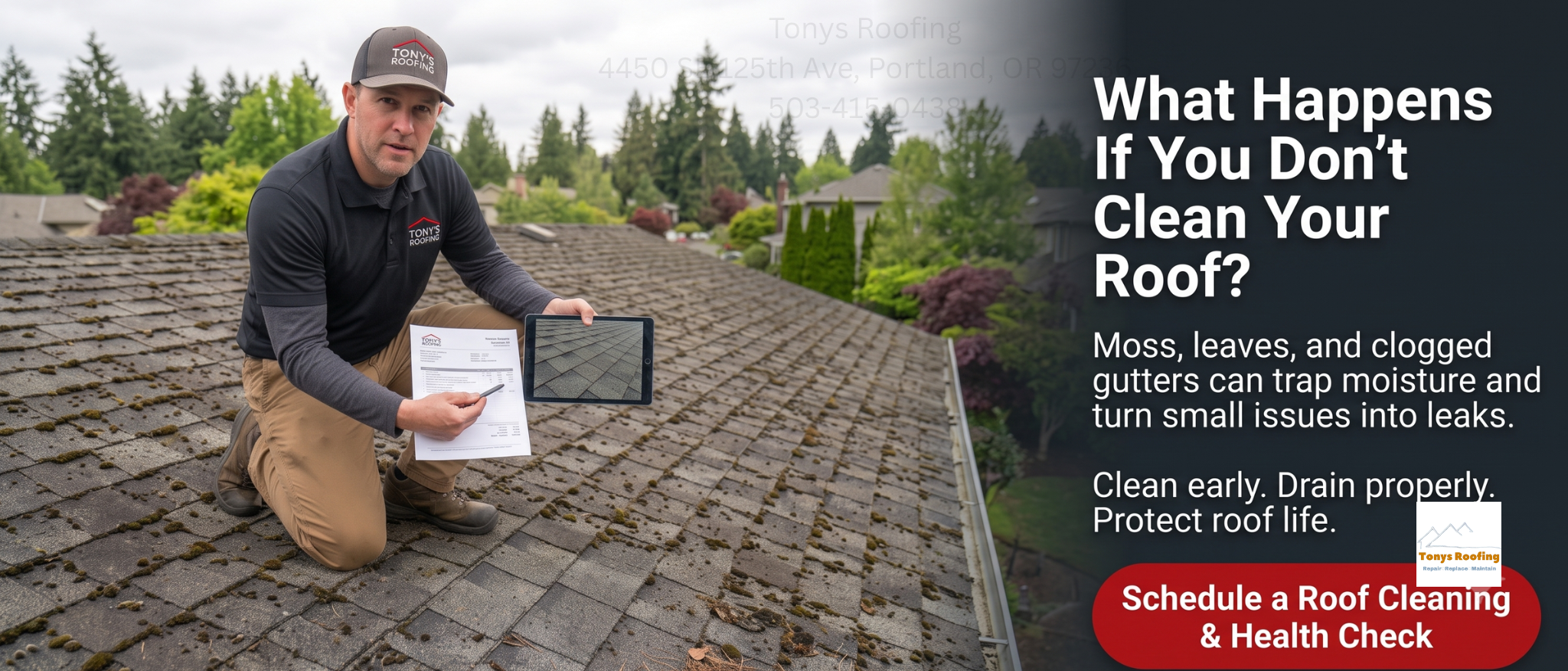
A man kneels on a shingled roof, showing a tablet and paper, with text about the importance of cleaning roofs to prevent damage and a red button for scheduling a roof cleaning.

What Happens If You Don’t Clean Your Roof?

Key Takeaways

  • Roof cleaning helps your roof dry faster, drain properly, and resist moss-related wear.
  • In Portland, skipping cleaning can lead to moss buildup, clogged gutters, roof-edge damage, and avoidable leaks.
  • The biggest risk is trapped moisture sitting against shingles, flashing, valleys, and gutters.
  • Avoid pressure washing asphalt shingles—it can damage the protective surface.
  • A photo-documented roof cleaning and health check helps you know whether you need cleaning, repair, or a larger plan.

A Dirty Roof Is Usually a Slow Problem, Not an Immediate One

It’s easy to put roof cleaning at the bottom of the home maintenance list—until a small issue becomes a leak. A dirty roof doesn’t always mean danger today, but it can create the conditions for damage tomorrow.

The goal isn’t to scare you. It’s to help you protect your home before the next rainy season.

You deserve clear guidance, not scare tactics.

Quick Answer: What Happens If You Skip Roof Cleaning?

If you don’t clean your roof, moss, algae, leaves, branches, and debris can trap moisture against roofing materials. Over time, that may lead to:

  • Faster shingle aging
  • Moss growth spreading
  • Clogged valleys and gutters
  • Water backing up near roof edges
  • Flashing and leak vulnerabilities
  • Fascia or decking damage
  • Avoidable repair costs
  • Shorter roof lifespan

A roof that stays wet too long ages faster.

Why This Matters More in Portland

Portland roofs have more reasons to stay damp than roofs in many other places:

  • Long rainy seasons
  • Mature trees and frequent leaf debris
  • Moss growth on shaded and north-facing slopes
  • Gutters that clog quickly in fall and winter
  • Roofs that dry slowly after storms
  • Older homes with vulnerable fascia, flashing, and attic moisture issues

In Portland, roof cleaning is less about curb appeal and more about moisture management.

What Can Happen If You Don’t Clean Your Roof

Information Table #1: Neglected Roof Condition

Neglected Condition What Can Happen Over Time Homeowner Risk
Leaves and debris in valleys Water flow slows or backs up Valley leaks, hidden underlayment damage
Clogged gutters Water spills over roof edges Fascia rot, siding stains, foundation moisture
Moss patches left untreated Moss thickens and holds moisture Shingle lifting, granule loss, shortened roof life
Algae or dark streaks ignored Surface stays damp and stained Reduced curb appeal, possible moisture retention
Branches rubbing shingles Abrasion during wind and rain Damaged shingles, exposed weak spots
Debris near flashing Water sits near chimneys, skylights, or walls Leak risk around penetrations
Heavy buildup over years Roof dries slowly after rain Faster aging and higher repair likelihood

Early Signs vs Serious Warning Signs

Information Table #2: When to Watch and When to Act

Early Signs to Address Soon Serious Warning Signs to Inspect Right Away
Small moss patches Moss lifting shingles
Leaves collecting in valleys Water stains on ceilings or attic decking
Gutters overflowing during rain Soft spots or sagging roof areas
Dark streaks or algae Missing, cracked, or curling shingles
Debris around skylights or chimneys Active leaks near flashing
Minor granule loss in gutters Repeated leaks after storms
Branches touching roof Fascia rot or gutter separation

Inline CTA: Not sure if your roof just needs cleaning or something more? Schedule a photo-documented roof health check.

The Hidden Chain Reaction

Most roof damage doesn’t start dramatically. It starts with water sitting where it shouldn’t.

Here’s how it usually goes:

  1. Debris collects in valleys, edges, gutters, and around roof penetrations.
  2. That debris traps moisture and slows drying.
  3. Moss and algae thrive in damp, shaded conditions.
  4. Moss holds water against shingles and can lift edges.
  5. Water finds weak points around flashing, vents, valleys, and roof edges.
  6. A small maintenance issue becomes a repair issue.

That’s why roof cleaning is really about stopping the chain reaction early.

What Roof Cleaning Helps Prevent

Regular roof cleaning helps protect against:

  • Clogged gutters and overflow
  • Moss spreading and thickening
  • Moisture trapped under debris
  • Damage around valleys and flashing
  • Premature shingle wear
  • Surprise leaks during the rainy season
  • Unnecessary early replacement

Roof cleaning is protective maintenance, not just a cosmetic service.

What Roof Cleaning Cannot Fix

Roof cleaning is helpful, but it has limits.

It cannot fix:

  • Rotten decking
  • Cracked or curled shingles
  • Failed flashing
  • Bad ventilation
  • Active leaks
  • End-of-life roof systems

A trustworthy roofer will tell you when cleaning is enough—and when there’s a bigger issue.

Common Mistakes Homeowners Make

We want you protected, not paying twice. Common mistakes include:

  • Waiting until a leak appears
  • Cleaning gutters but ignoring valleys
  • Pressure washing shingles
  • Scraping moss aggressively
  • Assuming moss means replacement
  • Assuming no leak means no issue
  • Hiring the cheapest cleaner without shingle-safe methods
FAQs
What happens if moss is left on a roof too long?

Moss can thicken, hold moisture, lift shingles, and accelerate wear. Over time, that increases the chance of leaks and shingle damage.

Can a dirty roof cause leaks?

Yes. Debris and moss can trap moisture and block drainage, which increases the risk of leaks around valleys, edges, and flashing.

How often should Portland homeowners clean their roofs?

It depends on shade, trees, and roof age, but many homes benefit from regular seasonal cleaning and annual roof checks.

Is roof cleaning just cosmetic?

No. It also helps control moisture, protect drainage, and slow moss-related damage.

Can clogged gutters damage my roof?

Yes. Overflow can soak roof edges, fascia, siding, and sometimes the underlayment at the roof line.

Is pressure washing a roof safe?

For asphalt shingles, generally no. It can damage the protective surface and shorten roof life.

Does roof cleaning extend roof life?

It can. Keeping water moving and removing debris helps roofs dry faster and reduces wear over time.

How do I know if my roof needs cleaning or repair?

If you see lifted shingles, leaks, soft spots, or recurring problem areas, it may be more than cleaning. A professional inspection can sort that out.

Should I clean my roof before selling my home?

Often yes. A clean roof improves curb appeal and helps avoid questions about moss, debris, or drainage issues during a sale.

Ready for a Safe, Straight‑Forward Next Step?

You don’t have to figure this out alone—or feel like you’re being sold at every turn.

Get an Honest Roof Evaluation (No Pressure)

  • Family‑owned, serving Portland for decades
  • Licensed & insured
  • Photo‑based findings + plain‑English explanations
  • We’ll tell you if a repair is enough—and if things look good, we’ll say that too

Request My Free Roof Replacement Quote


When you’re ready to take the next step, give us a call. We’re here to help.

Tony’s Roofing Contractors
(503) 415-0438

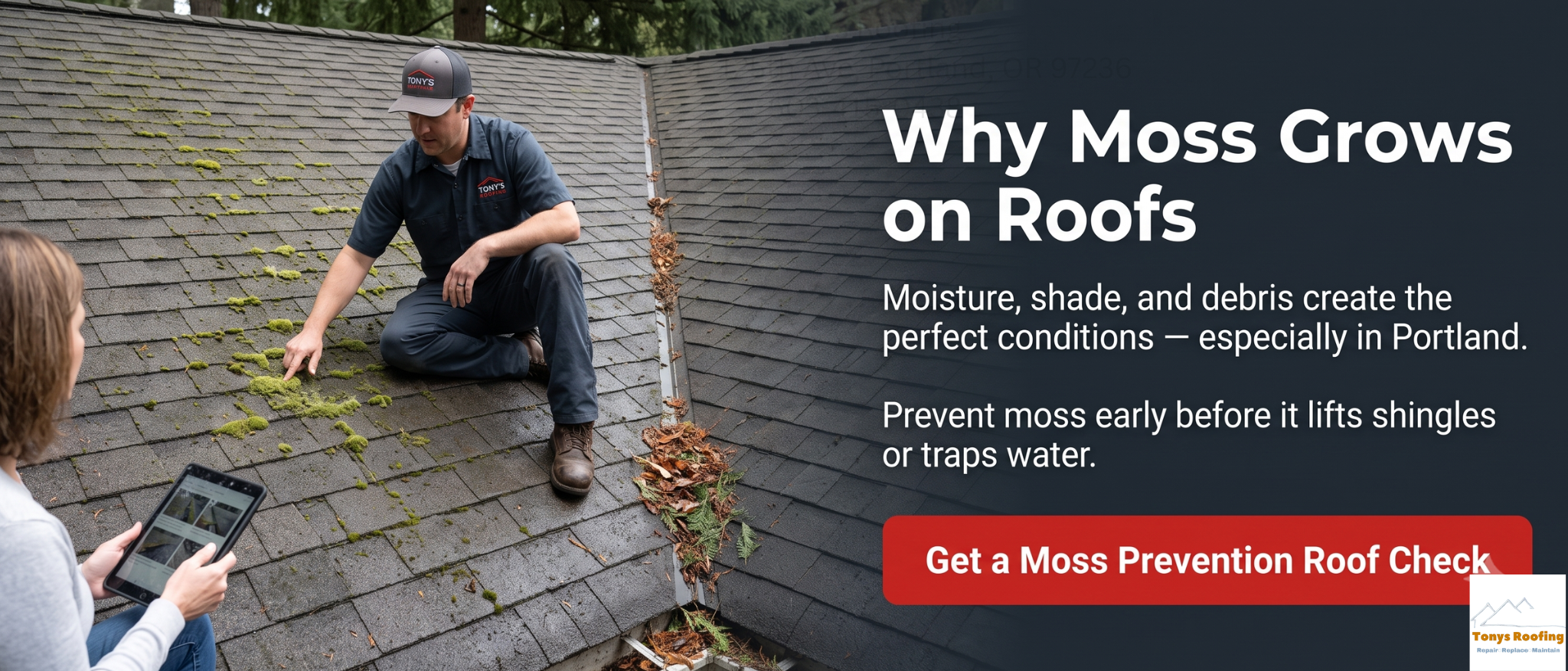
A roofer points to moss on a shingled roof while another person takes notes; text explains causes of roof moss and offers a moss prevention check.

Why Moss Grows on Roofs and How to Prevent It

Key Takeaways

  • Moss grows where moisture, shade, and debris combine.
  • Portland roofs are especially moss-prone because of rain, trees, and slower drying cycles.
  • Prevention is usually easier and cheaper than dealing with moss after it thickens.
  • Avoid pressure washing asphalt shingles—it can shorten roof life.
  • The safest next step is a shingle-safe moss prevention plan and a photo-documented roof health check.

Moss Grows Where Moisture Stays Too Long

Moss on a roof can look alarming, but it doesn’t automatically mean your roof is failing. The real issue is why it’s growing—and whether moisture is staying on your roof too long.

Moss is less about a dirty roof and more about a roof that stays wet too long. Once you understand the cause, prevention gets a lot easier.

You deserve the honest answer, not a scare tactic.

Quick Answer: Why Does Moss Grow on Roofs?

Moss grows when three conditions come together:

  • Moisture that lingers after rain
  • Shade that slows drying
  • Organic debris like leaves, pine needles, and branches that traps water and feeds growth

For Portland homeowners, that combination is especially common because of rain, tree cover, and shaded rooflines.

Why Portland Roofs Are Especially Moss-Prone

Portland roofs see moss more often because of:

  • Long rainy seasons
  • Cloud cover and slower drying cycles
  • Mature trees and falling debris
  • North-facing roof slopes
  • Valleys where leaves collect
  • Gutters that overflow or drain poorly
  • Older roofs that are losing granules

In Portland, moss prevention is part of roof ownership—not a sign you’ve done something wrong.

Why Moss Grows on Roofs

Information Table #1: Moss Growth Causes

Cause What It Does Homeowner Prevention Step
Shade from trees Slows roof drying after rain Trim branches where appropriate
Leaves and debris Trap moisture and feed growth Clear valleys and gutters regularly
North-facing roof planes Receive less sun exposure Monitor more often for moss
Clogged gutters Cause water overflow and wet roof edges Clean gutters seasonally
Poor airflow Keeps roof surfaces damp longer Evaluate attic and roof ventilation
Aging shingles Hold moisture more easily as granules wear Schedule annual roof health checks
Low-slope areas and valleys Water and debris collect longer Keep drainage paths clear

How to Prevent Moss

Information Table #2: Prevention Methods

Prevention Method How Effective It Is Best For Caution Notes
Regular debris removal High Tree-heavy homes Avoid walking unsafe roofs
Gutter cleaning High Heavy-rain areas Overflow can damage roof edges
Tree trimming Medium–High Shaded roofs Don’t over-trim without considering shade and heat
Gentle moss treatment High Early moss growth Use shingle-safe methods
Zinc or copper strips Medium Ongoing prevention Works best with proper placement and rain flow
Annual roof inspection High Older or shaded roofs Best when photo-documented
Pressure washing Not recommended None for asphalt shingles Can damage protective granules

How Moss Affects Shingles Over Time

Moss doesn’t usually destroy a roof overnight, but it can slowly cause real damage.

  • Moss holds moisture against shingles.
  • It can lift shingle edges as it thickens.
  • Trapped moisture can accelerate granule loss.
  • Water may work under shingles near valleys and edges.
  • Over time, moss can shorten roof life if ignored.

Moss is usually not an emergency—but it is something to manage before it becomes a bigger problem.

What Not to Do

The wrong moss removal method can do more damage than the moss itself.

  • Don’t pressure wash asphalt shingles.
  • Don’t scrape aggressively with metal tools.
  • Don’t use harsh treatments without protecting plants and runoff areas.
  • Don’t walk a wet or steep roof.
  • Don’t assume a mossy roof automatically needs replacement.
Annual Moss Prevention Checklist

Use this checklist once a year, and more often if your roof is shaded or tree-covered.

  • Check your roof from the ground after rainy stretches.
  • Clean gutters in fall and spring.
  • Clear valleys and roof edges where debris collects.
  • Trim branches that touch or heavily shade the roof.
  • Watch north-facing slopes and shaded areas.
  • Treat early moss before it thickens.
  • Schedule a photo-documented roof check once a year, especially for older roofs.
When to Call a Professional

Call a pro if:

  • Moss is thick or widespread.
  • Shingles appear lifted, cracked, or bald.
  • Moss is concentrated near valleys, skylights, or chimneys.
  • Gutters overflow even after cleaning.
  • You see stains, leaks, or soft spots.
  • The roof is steep, wet, or unsafe to access.
  • You’re unsure whether cleaning, repair, or replacement is needed.

We’ll tell you if prevention is enough.

FAQs
Why does moss grow on my roof but not my neighbor’s?

Differences in shade, tree cover, roof pitch, ventilation, and drainage can all change how much moisture stays on a roof.

Is moss on a roof bad or just cosmetic?

It can start as a cosmetic issue, but moss can hold moisture, lift shingles, and shorten roof life if it keeps growing.

Can moss cause roof leaks?

Yes. Moss can trap water and push it under shingles, especially in valleys, edges, and around roof details.

How often should I treat my roof for moss in Portland?

It depends on shade and debris, but many homes benefit from regular seasonal checks and early treatment before moss thickens.

Are zinc or copper strips worth it?

They can help slow regrowth, especially when installed correctly and paired with debris control and drainage maintenance.

Can I remove roof moss myself?

Light, safe maintenance may be possible from the ground or on very low-risk areas, but thick moss and roof-surface work are better handled by professionals.

Is pressure washing a roof safe?

For asphalt shingles, generally no. It can strip protective granules and damage the roof surface.

Does moss mean I need a new roof?

Not automatically. The real question is whether the roof is still structurally sound underneath the moss.

What time of year is best for moss prevention?

Dryer months are usually best for cleaning, treatment, trimming, and inspection because roofs dry faster and are safer to access.

Ready for a Safe, Straight‑Forward Next Step?

You don’t have to figure this out alone—or feel like you’re being sold at every turn.

Get an Honest Roof Evaluation (No Pressure)

  • Family‑owned, serving Portland for decades
  • Licensed & insured
  • Photo‑based findings + plain‑English explanations
  • We’ll tell you if a repair is enough—and if things look good, we’ll say that too

Request My Free Roof Replacement Quote


When you’re ready to take the next step, give us a call. We’re here to help.

Tony’s Roofing Contractors

(503) 415-0438

A man and a woman review roofing documents at a table. Inset shows review categories: communication, cleanup, support, and follow-through. Text advises checking more than ratings for roofing services.

Can You Trust Online Roofing Reviews?

Key Takeaways

  • Online roofing reviews are helpful, but they should be read as patterns—not isolated opinions.
  • Strong reviews mention communication, cleanup, follow-through, and problem-solving.
  • Be cautious of vague reviews, sudden clusters, and companies that respond poorly to criticism.
  • Reviews cannot replace checking license, insurance, scope, warranty, and local accountability.
  • The safest next step is to combine review research with a clear estimate and a no-pressure conversation.

Reviews Help, But They Don’t Tell the Whole Story

Reading reviews is smart. Trusting them blindly is risky. A five-star rating doesn’t always mean the best contractor—and one bad review doesn’t always tell the full story.

The key is knowing what patterns to look for. You deserve clear signals, not marketing noise.

Quick Answer: Can You Trust Online Roofing Reviews?

Yes, online roofing reviews can be useful—but only when you read them in context.

Look for patterns across multiple reviews, not just star ratings. Strong reviews usually mention communication, cleanup, follow-through, timelines, warranty support, and how the company handled problems when things got real.

Reviews are a starting point—not the finish line.

What Reviews Are Useful For

Good roofing reviews can tell you a lot about how a company behaves before, during, and after the job.

They often reveal:

  • Communication style – Did the contractor explain things clearly and keep the homeowner updated?
  • Timeliness – Did they show up when promised and finish on schedule?
  • Crew professionalism – Were the workers respectful, organized, and careful on site?
  • Cleanup quality – Did they leave the property clean and safe?
  • Follow-through – Did they return to address questions or minor issues after the job?
  • How problems were handled – Did they respond calmly and fix the issue instead of avoiding it?

In plain English: good roofing reviews usually tell you how the company acts when things get real.

What Reviews Do Not Tell You

Reviews are helpful, but they can hide just as much as they reveal.

They do not always tell you:

  • Whether the roof was installed correctly long-term
  • Whether flashing and ventilation were handled properly
  • Whether the materials were appropriate for the home
  • Whether the warranty terms were actually strong
  • Whether the contractor will still answer the phone years later
  • Whether the cheapest quote was actually a good value

A roof can look fine the week it’s installed. The real test is how it performs after seasons of rain.

Review Signals to Look For

Information Table #1: Helpful Review Details

Review Detail Why It Matters Strong Signal Example
Clear communication Shows the homeowner was kept informed. “They explained everything and sent updates.”
Photo documentation Suggests transparency and proof of work. “They showed what needed repair.”
Cleanup comments Reflects crew discipline and care. “They left the yard cleaner than they found it.”
Follow-through Indicates accountability after the job. “They came back promptly when we had a question.”
Warranty/support mentions Shows long-term care and education. “They helped us understand the warranty.”
Specific crew/project details Suggests the review is authentic. “They replaced flashing and repaired decking.”
Problem resolution Reveals character under pressure. “There was an issue, and they fixed it.”

If a review tells you what happened, how the company responded, and why it mattered, that’s useful.

Green Flags vs Red Flags

Information Table #2: Review Patterns to Trust or Question

Green Flags Red Flags
Reviews mention specific project details Reviews are vague or generic
Multiple reviews praise communication Many complaints about no-shows or delays
Homeowners mention cleanup and respect Complaints about mess, nails, or property damage
Contractor responds calmly to criticism Defensive or hostile responses
Reviews spread naturally over time Sudden cluster of similar reviews
Reviews mention warranty/help after the job Complaints about disappearing after payment
Balanced mix of project types Only price-focused praise

A few imperfect reviews can actually make a profile feel more real if the contractor’s response is professional.

How to Read Review Patterns

Don’t judge by one glowing review or one angry one. The best signal is consistency.

Here’s how to do that:

  • Look for repeated themes over months and years.
  • Compare star rating with the actual substance of the review.
  • Read both recent and older reviews.
  • Pay attention to how the contractor responds to criticism.
  • Notice whether the complaints are about one-off issues or the same problems over and over.

A single bad review may just mean a bad day. A pattern of poor communication, cleanup issues, or disappearing after payment is different.

How to Compare Reviews Across Platforms

Different platforms can tell slightly different stories, so use more than one.

  • Google – Often the first place homeowners check, and usually the broadest picture.
  • Yelp – Can skew strongly positive or negative depending on reviewer behavior.
  • Facebook / Nextdoor – Helpful for neighborhood-level trust signals and local word of mouth.
  • BBB or state/local records – Useful for complaints and business legitimacy.
  • Company website testimonials – Helpful, but curated, so treat them as selected examples rather than the full picture.

Use reviews to build questions—not to skip due diligence.

What to Check Beyond Reviews

Reviews are only one piece of contractor trust. A trustworthy roofer won’t ask you to rely on reviews alone.

Before hiring, also check:

  • License and insurance
  • Local address and years serving the area
  • Written scope and estimate details
  • Materials and warranty information
  • References you can actually call
  • Photos of past work
  • How they communicate during the estimate process
  • Whether they educate or pressure you

That’s the difference between liking the marketing and trusting the contractor.

FAQs: Reading Roofing Reviews Wisely
Can roofing reviews be fake?

Yes. Fake or manipulated reviews can happen, including generic praise, repeated wording, or suspicious bursts of reviews posted close together. That’s why patterns matter more than a star average.

How many reviews should a roofer have before I trust them?

There’s no magic number. More important than count is whether the reviews are recent, specific, and consistent over time.

Is a 5-star rating always better?

Not necessarily. A company with a slightly lower average but many detailed, consistent reviews may be more trustworthy than a perfect score with vague praise.

Should I trust Yelp, Google, Facebook, or Nextdoor more?

Use them together. Google is often the broadest starting point, Yelp can be more polarized, and Facebook/Nextdoor can be helpful for local community feedback.

What should I do if a contractor has one bad review?

Read it carefully and ask whether it’s a one-off or a pattern. Also look at how the company responded; a calm, helpful response can matter more than the complaint itself.

Are website testimonials reliable?

They can be useful, but they’re curated. Treat them as examples the company chose to highlight, not a complete picture of customer experience.

How can I tell if reviews are too generic?

Watch for short, vague comments like “Great job!” or “Best company ever!” with no project details, no names, and no explanation of what was done.

Should I ask for references even if reviews are good?

Yes. Reviews and references serve different purposes. Reviews show public patterns, while references let you ask direct questions about communication, cleanup, and follow-through.

What matters more: reviews or the written estimate?

Both matter, but the written estimate often tells you more about the actual scope, materials, and protections you’re buying. Reviews help you decide who to trust; the estimate shows you what you’re actually getting.

Ready for a Safe, Straight‑Forward Next Step?

You don’t have to figure this out alone—or feel like you’re being sold at every turn.

Get an Honest Roof Evaluation (No Pressure)

  • Family‑owned, serving Portland for decades
  • Licensed & insured
  • Photo‑based findings + plain‑English explanations
  • We’ll tell you if a repair is enough—and if things look good, we’ll say that too

Request My Free Roof Replacement Quote


When you’re ready to take the next step, give us a call. We’re here to help.

Tony’s Roofing Contractors

(503) 415-0438

Two people examine a house’s gutters; one points at the gutter while the other holds a tablet. Text discusses factors for replacing gutters with a new roof and offers a roof and gutter evaluation.

Do You Need to Replace Your Gutters When Replacing the Roof?

Key Takeaways

  • You do not always need to replace gutters when replacing the roof.
  • Gutters should be judged by drainage, slope, leaks, attachment, size, and fascia condition.
  • In Portland, gutters matter a lot because rain and tree debris can quickly create overflow and roof-edge damage.
  • Replacing gutters during a roof project can be smart if they’re failing, undersized, or already affecting the fascia and roof edge.
  • A trustworthy roofer will tell you whether keeping, repairing, or replacing the gutters makes the most sense.

Not Always — But Sometimes It’s the Smart Move

You do not always need to replace gutters when replacing a roof. If your gutters are draining well, securely attached, correctly sized, and not showing leaks or rust, they may be perfectly fine to keep.

The honest answer is that it depends on gutter condition, fascia health, drainage performance, and whether the existing system can still protect the new roof edge properly.

You deserve clear answers—not another upsell.

How Roofs and Gutters Work Together

Your roof sheds water. Your gutters catch it and move it away from the fascia, siding, and foundation.

A new roof can only do its job if that water has somewhere safe to go. If the gutters are failing, overflowing, or pulling away, water can back up into roof edges and damage the new investment.

That’s why a good roofer looks at the whole water-management system, not just shingles.

Keep, Repair, or Replace?

Information Table #1: Gutter Decision Guide

Gutter Condition Best Next Step Why
Gutters drain well, no leaks, securely attached Keep No need to replace what’s working.
Minor leaks at seams or loose brackets Repair Small fixes may restore performance without full replacement.
Sagging or pulling away from fascia Repair or replace Water may overflow and damage roof edges, fascia, and siding.
Rust, holes, cracks, or major seam failure Replace Continued leaks can damage the home and often point to end-of-life gutters.
Undersized for roof size or heavy rain Replace / upgrade Portland rain can overwhelm weak systems; larger gutters or downspouts may be needed.
Fascia rot behind gutters Evaluate with the roof project Hidden damage may affect both systems and change the scope.
Repeated overflow despite cleaning Replace / resize / adjust downspouts The problem may be design or capacity, not just debris.


Gutter Problems and Roof Risk

Information Table #2: Problem → Risk → Next Step

What You Notice Possible Roof / Home Risk Recommended Next Step
Water spilling over gutters Fascia rot, siding damage, foundation issues Clean, inspect slope, and evaluate whether the gutters are sized correctly.
Gutters pulling away Water behind gutter, damaged fascia Inspect fascia and fasteners before deciding to keep them.
Debris packed in gutters or valleys Water backup under the roof edge Clean gutters and inspect roof edge drainage.
Downspouts dumping near foundation Basement or crawlspace moisture Extend drainage away from the home.
Rusted or leaking seams Water where it shouldn’t be Repair or replace the affected sections.
Black staining under gutters Chronic overflow or leaks Inspect the gutter system and fascia together.
When Replacing Gutters During Roof Work Makes Sense

Replacing gutters during roof replacement can be a smart move when:

  • The gutters are already near the end of their life.
  • Fascia boards need repair or replacement.
  • Gutters are pulling away, sagging, or leaking in multiple places.
  • The system is undersized for the roof pitch, roof area, or Portland rain.
  • You want seamless gutters or larger downspouts for lower maintenance and better drainage.
  • Drainage problems have already caused repeat damage at the roof edge or siding.

If the gutters are failing, replacing them while the roof is being done can prevent duplicate labor and future damage.

When You Probably Don’t Need New Gutters

This is the part homeowners often don’t hear enough: sometimes the right answer is keep the gutters.

You can often leave them in place if:

  • They’re relatively new.
  • They’re not leaking or sagging.
  • They’re securely attached and properly sloped.
  • Downspouts are in the right place and moving water away from the house.
  • There’s no sign of fascia rot behind them.
  • They’re not overflowing during normal storms.

A trustworthy contractor won’t replace gutters just because they’re already on site.

Portland Factors That Matter

Portland homes put gutter systems under real pressure:

  • Heavy seasonal rain can overwhelm undersized or worn systems.
  • Mature trees mean more leaves, needles, and roof debris.
  • Moss and debris in valleys can push extra water into the gutter line.
  • Older homes often have aging fascia that may be hiding rot behind the gutters.
  • Steeper rooflines can dump water fast, so gutter capacity matters more than it might in drier climates.

In Portland, gutters aren’t cosmetic. They’re part of how your home survives the rainy season.

Cost and Timing Considerations

Replacing gutters during roof replacement can be more efficient because the crew is already mobilized and the roof edge is already open for work. But that doesn’t mean the add-on should be automatic.

A good estimate should clearly separate:

  • Roof work
  • Gutter work
  • Fascia repair
  • Downspout changes
  • Disposal and cleanup

If the contractor can’t explain why the gutters need replacement, or the quote lumps everything together without clarity, ask for a revision. Transparency matters more than speed.

FAQs: Roof and Gutter Replacement
Do roofers remove gutters during roof replacement?

Sometimes, but not always. Many roofers can work around existing gutters if they’re in good shape, though removal or protection may be needed depending on the roof edge details and project scope.

Can old gutters damage a new roof?

Yes. Old, sagging, or overflowing gutters can send water back toward the roof edge and fascia, which can shorten the life of the new roof system.

Should gutters be installed before or after the new roof?

In most cases, the roof comes first, then gutters are adjusted or installed to match the finished roof edge and drip line. The exact sequence depends on the contractor’s plan and your existing system.

How do I know if my gutters are still good?

Look for signs like:

  • Strong water flow during rain
  • No leaks at seams
  • No sagging or pulling away
  • No rust, holes, or major stains
  • No overflowing during normal storms
Are seamless gutters worth it?

They can be, especially if your current system leaks at seams or needs a capacity upgrade. Seamless gutters generally have fewer leak points and can be a good long-term fit for Portland weather.

What if my fascia is rotted behind the gutters?

That needs to be addressed. Fascia rot can affect both the gutter attachment and the roof edge, so it should be evaluated as part of the roof project.

Do clogged gutters cause roof leaks?

Yes. Clogged gutters can overflow and push water back toward the roof edge, fascia, and underlayment, which can lead to leaks and rot.

Should downspouts be replaced too?

If they’re rusted, damaged, undersized, or dumping water too close to the foundation, yes—they may need to be repaired or replaced along with the gutters.

Can I replace gutters later after the roof is done?

Yes. But if they’re already failing, bundling the work may save time, reduce duplicate labor, and prevent a second disruption later.

Ready for a Safe, Straight‑Forward Next Step?

You don’t have to figure this out alone—or feel like you’re being sold at every turn.

Get an Honest Roof Evaluation (No Pressure)

  • Family‑owned, serving Portland for decades
  • Licensed & insured
  • Photo‑based findings + plain‑English explanations
  • We’ll tell you if a repair is enough—and if things look good, we’ll say that too

Request My Free Roof Replacement Quote


When you’re ready to take the next step, give us a call. We’re here to help.

Tony’s Roofing Contractors

(503) 415-0438

Two people examine moss on a house roof using a tablet, with text discussing moss and roof replacement options.

Do I Need to Replace My Roof if I See Moss or Algae?

Key Takeaways

  • Moss and algae are very common in Portland—and they don’t automatically mean you need a new roof.
  • The key is severity + what’s happening underneath: light growth on a younger roof is often a cleaning/treatment issue; thick moss with shingle damage or leaks can be a replacement conversation.
  • Moss actively holds water, lifts shingles, and accelerates wear, especially in our long wet season.
  • Avoid pressure washing asphalt shingles; it often causes more harm than good and may void warranties.
  • Valleys, gutters, and flashing are where moss‑related problems escalate fastest—those areas deserve careful inspection.
  • The safest next step is a photo‑documented evaluation so you can know, with confidence, whether cleaning, repair, or replacement is truly needed.

Moss on Your Roof Feels Like a Warning Sign

Seeing green moss or dark streaks on your roof can make your stomach drop—especially if you’ve already heard someone say, “That means you need a whole new roof.”

In Portland’s wet, tree‑covered neighborhoods, moss and algae are extremely common, and they don’t automatically mean your roof is done. In many cases, the right next step is cleaning, treatment, and a prevention plan, not replacement.

You deserve clear answers, not pressure.

Quick Answer: Does Moss Automatically Mean I Need a New Roof?

No. Moss or algae do not automatically mean you need a full roof replacement.

Replacement is usually considered only when moss is paired with things like:

  • Widespread shingle damage (curling, cracking, bald spots)
  • Repeated or active leaks
  • Soft or rotten decking under the shingles
  • End‑of‑life roof age (often 20–25+ years here, depending on material and conditions)

In many Portland homes, especially where the roof is under 15–20 years old and still structurally sound, the right move is:

  • Professional moss/algae cleaning and treatment, plus
  • A simple maintenance and prevention plan going forward

The key is understanding severity and what’s happening underneath.

Why Moss and Algae Are So Common in Portland

Our climate is almost tailor‑made for moss and algae:

  • Long wet seasons – From roughly October through May, Portland roofs stay damp for months, giving moss and algae ideal conditions to grow.
  • Tree cover and shade – Mature trees drop debris and block sunlight, keeping roof surfaces wet longer.
  • North‑facing and shaded slopes – These areas dry out the slowest and are the first to show moss and algae growth.
  • Organic debris buildup – Needles and leaves trap moisture against the roof, feeding moss and algae.

In short: moss is normal here—but it’s not harmless. Left alone, it absolutely shortens roof life.

Moss & Algae Severity Levels: What You’re Seeing and What It Means

Use this table to get a rough sense of where you are on the spectrum. It’s not a diagnosis—but it helps frame the conversation.

Information Table #1: Moss/Algae Severity Levels

What You See Likely Severity What It Usually Means Best Next Step
Light green film or faint dark streaks on shingles, mostly cosmetic discoloration Low Likely algae or very early moss that’s mostly on the surface; shingles appear intact and flexible. Gentle professional cleaning/treatment and basic prevention (tree trimming, debris removal).
Small, scattered moss patches (coin‑ to hand‑size), especially on north‑facing areas Moderate Moisture is lingering in certain spots; moss is starting to hold water and get under some shingle edges. Professional moss removal and treatment, plus an inspection to confirm shingles and decking are still sound.
Thick moss along valleys, lower edges, and around gutters Higher Water flow is being blocked; these areas are staying wet for long periods, stressing shingles and underlayment. Cleaning + valley/gutter corrections + inspection for early damage; repairs may be recommended in affected sections.
Shingles lifting, bald spots, or cracking are visible when moss is brushed back Serious Moss has begun lifting shingles and accelerating granule loss; potential for water getting under the roof surface. Professional evaluation for targeted repairs; depending on age and spread, replacement of sections or whole roof may be discussed.
Moss plus active leaks, ceiling stains, or soft spots when walking the roof High risk Damage likely extends beneath shingles into underlayment and decking; water intrusion is already happening. Full roof and attic evaluation; expect a conversation about structural repairs and whether replacement is the smarter long‑term move.

Not sure which level you’re in? A short, photo‑documented inspection will usually answer that quickly—without any pressure to replace if you don’t need to.

Clean/Treat vs. Repair vs. Replace: How to Think About It

Here’s a simplified way to think about the likely next step based on what’s found.

Information Table #2: Clean/Treat vs Repair vs Replace

Situation Clean/Treat Likely Enough? Repair Likely Needed? Replacement More Likely?
Roof under ~15 years old, moss/algae is light and mostly cosmetic ✅ Yes
Moss isolated to a few shaded areas; shingles still flexible and intact ✅ Yes (with pro treatment) ✅ Possibly in limited spots (individual shingles or small areas)
Moss is thick in valleys and along edges; gutters have overflowed from debris ✅ Yes, with debris correction ✅ Often – valley, edge, or gutter‑related repairs
Shingles curling, cracking, or losing granules across multiple slopes (with or without moss) ✅ Sometimes – but repairs may only buy a little time ✅ More likely, especially if roof is 20–25+ years old
Soft decking, recurring leaks, or moss on a clearly end‑of‑life roof ✅ High likelihood replacement is the smarter, safer investment

These aren’t hard rules, but they reflect how most Portland roofs behave in real life.

What Moss Actually Does to Shingles (Plain English)

Moss on your roof isn’t just sitting there—especially in our climate. It actively changes how your roof behaves:

  • Moss traps moisture like a sponge
    Moss absorbs and holds water against the shingle surface, keeping it wet for much longer after each rain. Over months and years, that constant moisture speeds up shingle aging.
  • Roots/holdfasts lift shingle edges
    As moss grows thicker, it works its way under shingle tabs and expands, physically lifting edges and creating tiny gaps. Those gaps are where water begins to travel under the roofing surface.
  • Granule loss and surface wear
    Trapped moisture and freeze‑thaw cycles weaken the bond between granules and the shingle, causing bald spots and roughened surfaces. Those granules are your UV and weather protection—once they’re gone, shingles age quickly.
  • Blocked drainage in valleys and along edges
    Thick moss forms little “dams” that slow water, push it sideways, and hold it against vulnerable areas like valleys and lower edges. That’s how moss in a valley can lead to leaks even if the field shingles look okay.

In wood roofs, moss also traps debris and soil, encouraging fungi that decompose the wood faster.

Common Myths & Bad Advice About Moss

Let’s clear up a few things that can do more harm than good.

“It’s Just Cosmetic—I Can Ignore It”

  • Algae stains (dark streaks) are often mostly cosmetic at first, though they can contribute to heat retention and minor extra wear.
  • Moss, on the other hand, is widely recognized as detrimental to asphalt shingle performance and roof longevity.

Ignoring moss until you see a leak usually means you’re paying for structural repairs, not just cleaning.

“I’ll Just Pressure Wash It Off”

High‑pressure washing is one of the most damaging things you can do to asphalt shingles:

  • Strips away protective granules
  • Can crack or dislodge shingles
  • Forces water up under the roofing, causing leaks
  • Often voids manufacturer warranties

Manufacturers and industry groups specifically recommend not using pressure washers on asphalt shingles.

“Bleach-Only DIY Is Always Fine”

Bleach solutions are a common professional tool, but:

  • They must be mixed and applied correctly (often around a 50:50 bleach: water ratio with low‑pressure rinse).
  • Landscaping and metal components (like copper gutters/flashings) need careful protection.
  • Over‑application or improper rinsing can cause damage.

If you’re not comfortable working on a roof or handling chemicals safely, it’s worth bringing in a pro.

“Coating Over Moss Will Fix It”

Coating over active moss or a damp, moss‑damaged roof can trap moisture inside and accelerate underlying damage. Any coating or sealant conversation should only happen after moss is fully removed and the roof’s condition is evaluated.

When Moss Is a Warning Sign of Deeper Problems

Moss itself is a problem—but sometimes it’s also a symptom of something else going wrong.

  • Persistent moss in valleys
    Often goes hand‑in‑hand with debris buildup and poor drainage, which can cause water to run sideways under shingles and into decking.
  • Moss clustering near chimneys, skylights, or walls
    These are classic flashing areas; moss plus these details increases the chance that small flashing gaps turn into leaks.
  • Moss + attic condensation or musty smells
    Suggests the roof is staying damp from both sides—outside moss and inside moisture/ventilation issues.
  • Moss plus recurring stains or leaks inside
    Indicates water has already made it past the shingles and underlayment and is affecting the decking, insulation, and drywall.

These are strong reasons to get a full, photo‑documented evaluation instead of just a surface cleaning.

FAQs: Moss, Algae, and Roof Replacement

Does moss always mean my roof is failing?

No. Early or moderate moss on an otherwise healthy roof does not mean automatic failure, but it does mean your roof needs attention. Long‑term, unchecked moss will shorten roof life and can lead to failure if ignored.

Can moss cause leaks, or is it just cosmetic?

Moss is not just cosmetic. It traps moisture, lifts shingle edges, and can redirect water under shingles—especially in valleys and along edges—leading to leaks and decking damage.

Is roof cleaning safe for asphalt shingles?

Done correctly with low‑pressure methods and appropriate cleaners, yes. Done with high‑pressure washing or aggressive scrubbing, it can strip granules and damage shingles. This is why many homeowners prefer hiring a pro for moss treatment here.

How often should roofs be treated for moss in Portland?

It depends on shade and debris, but many Portland roofs benefit from inspection and treatment every 1–3 years, especially on north‑facing and tree‑covered slopes. Annual checks are smart for high‑risk homes.

Will moss removal damage my shingles?

Gentle methods—involving appropriate chemical treatments, soft rinsing, and very light brushing if needed—are designed to minimize abrasion and protect granules. Over‑brushing or scraping, on the other hand, can cause damage. Technique matters.

Can moss void my roof warranty?

Most manufacturer warranties require that roofs be properly maintained; long‑term neglect, heavy moss, or improper cleaning (like pressure washing) can be cited as reasons to deny claims. Keeping moss in check is part of protecting your warranty.

What’s the difference between moss and algae streaks?

  • Algae – Typically appears as dark/black streaks or stains; mostly cosmetic at first, though it can hold moisture and warm the roof surface.
  • Moss – Green, fuzzy clumps or mats; more destructive because it traps water and can lift shingles.

Both benefit from cleaning and prevention, but moss is the bigger structural concern.

Should I replace my roof if moss keeps coming back?

Not necessarily. Persistent moss may mean:

  • Environmental factors (deep shade, heavy debris)
  • Lack of regular cleaning/treatment
  • Ventilation or moisture issues

If the roof is still structurally sound, a stronger maintenance and prevention plan may be enough. If moss has already caused shingle and decking damage across large areas—especially on an older roof—replacement might be the more cost‑effective long‑term move.

Are zinc strips or treatments worth it?

Zinc and copper ions help prevent regrowth and are widely used in the Pacific Northwest. On existing roofs, surface‑applied treatments (granules, powders, or liquids) are generally preferred over retrofitting metal strips under shingles, which can disrupt seals and introduce fastener holes if not done carefully.

Ready for a Safe, Straight‑Forward Next Step?

You don’t have to figure this out alone—or feel like you’re being sold at every turn.

Get an Honest Roof Evaluation (No Pressure)

  • Family‑owned, serving Portland for decades
  • Licensed & insured
  • Photo‑based findings + plain‑English explanations
  • We’ll tell you if a repair is enough—and if things look good, we’ll say that too

Request My Free Roof Replacement Quote


When you’re ready to take the next step, give us a call. We’re here to help.

Tony’s Roofing Contractors

(503) 415-0438

A man and woman review a roofing contractor checklist at a table with documents and a tablet; text highlights steps for vetting a contractor.

How to Vet a Roofing Contractor (Checklist for Homeowners)

Key Takeaways

  • Verify license, insurance, and workers’ comp first—before talking price or materials.
  • Choose a contractor you can still call years from now; local accountability and a real address matter.
  • Compare quotes by scope, not just price—make sure flashing, ventilation, decking policy, cleanup, and warranties are all clear.
  • A professional estimate is line‑itemed, photo‑documented, and backed by written warranties—not pressure tactics.
  • If a contractor won’t explain, document, or answer questions clearly, walk away.


You Deserve a Contractor You Can Call Years From Now

Most homeowners only replace a roof once or twice in their lives, which makes picking the right contractor feel high‑stakes.

The good news: you don’t need to become a roofing expert to protect yourself—you just need a clear, simple vetting checklist and 15–30 minutes to use it.

You deserve clear answers, not pressure.

Quick Answer: The 5 Must‑Check Items

Before you worry about shingle brands or colors, confirm these five things:

  1. License – Active, in good standing, and correctly classified for roofing work in Oregon.
  2. Insurance certificate – General liability and workers’ comp, verified via an official Certificate of Insurance (COI).
  3. Local address + longevity – A real physical location and a local history that shows they’ll still be here tomorrow.
  4. Written scope – A line‑item estimate that spells out materials, flashing, ventilation, decking policy, and cleanup.
  5. Warranty clarity – Written explanation of both manufacturer and workmanship warranties, and what can void them.

If a contractor passes those five checks, you’re starting from a much safer place.

The Full Vetting Checklist (Step‑by‑Step)

Break your vetting into four quick stages. You can do most of this from your kitchen table.

Stage A — Identity & Legitimacy

Goal: Confirm they are who they say they are—and that Oregon actually recognizes them.

  • Business name matches license and insurance
    In Oregon, anyone paid to repair or improve a home (including roofers) must be licensed with the Construction Contractors Board (CCB).

    • Ask for their CCB license number.
    • Look it up using the state’s online search or tools like OR CCB.
    • Make sure the company name and status match.
  • Local physical address (not just a PO box)
    Search the address in Google Maps and on their website; you’re looking for a real, consistent business location.
  • Years in business locally
    Check their license history and complaint record, which in Oregon can go back up to 10 years.
  • Reviews across platforms
    Look for consistent patterns in Google, Yelp, BBB, or other platforms—recurring themes matter more than one‑off perfect or angry reviews.

Stage B — Safety & Liability

Goal: Make sure you’re protected if someone gets hurt or something gets damaged.

  • Certificate of Insurance (COI)
    A roofer “saying” they’re insured is not enough. Ask their agent to email you a Certificate of Insurance that shows:

    • General liability coverage (protects your property)
    • Workers’ compensation coverage (protects you if a worker is injured on your property)
  • Without workers’ comp, an injured worker may have the legal right to sue the homeowner.
  • Workers’ comp listed on the COI
    Confirm it’s active and issued to the same company name that’s on your estimate and contract.
  • Safety procedures
    Ask how they handle fall protection, debris control, and protecting landscaping, siding, and windows.

Stage C — Scope & Quality

Goal: Make sure the quote covers a complete, long‑lasting roof—not just the bare minimum.

A professional estimate usually includes these items in writing:

  • Detailed materials list
    • Shingle/roofing brand and product line
    • Underlayment type (synthetic vs. felt; ice/water shield areas)
    • Ridge caps, starter strips, fasteners
  • Flashing plan
    Very few leaks start in the middle of a shingle field—they start at chimneys, walls, skylights, and vents.
    Your estimate should clearly say which flashings are being replaced and how.
  • Ventilation check
    Healthy roofs need balanced intake and exhaust ventilation; in Oregon’s climate, this affects both performance and warranty validity.
    Look for notes about attic inspection, soffit/ridge vents, or other exhaust options.
  • Decking policy
    There should be a clear plan for replacing rotten or damaged wood, usually as:

    • A per‑sheet price, and/or
    • An allowance, plus a written change‑order process
  • Cleanup plan
    Including dumpster/haul‑off and magnet nail sweep expectations, multiple passes are common for safety.

Stage D — Trust & Communication

Goal: Choose someone you can communicate with comfortably before, during, and after the job.

  • References you can call
    Ask for 2–3 recent local homeowners. Call and ask what went well, what could’ve been better, and whether they’d hire the contractor again.
  • Timeline expectations & weather policy
    You should know the expected start window, approximate duration, and how weather delays are handled.
  • Communication plan
    Ask who your main contact will be, how you’ll get updates, and how issues are handled during the job.
  • Payment terms
    Look for a reasonable deposit (not most of the job up front), with the balance due at clearly defined milestones or at substantial completion.

Verification Checklist: What to Check, How, and What “Good” Looks Like

Information Table #1: Verification Checklist

What to Verify How to Verify What “Good” Looks Like
License Use Oregon CCB’s online search or a tool like OR CCB; enter the license #. License is active, matches the company name, correct classification, and no serious unresolved complaints.
Insurance (General Liability) Request a Certificate of Insurance from the contractor’s agent. Current policy with appropriate limits, issued to the contractor named on your quote.
Workers’ Comp Confirm workers’ comp coverage is listed on the COI. Active workers’ comp policy; protects you from injury claims if someone is hurt on your property.
Local Address Check the address on Google Maps, website, and paperwork. Real business location (office/shop), not only a PO box; consistent across documents.
References Call 2–3 recent clients provided by the contractor. Homeowners confirm good communication, cleanup, and that the contractor returned if minor issues came up.
Written Scope Review the line‑item estimate. Clear description of materials, flashing, ventilation, decking policy, cleanup, and warranties; not a single line “replace roof.”
Warranty Ask for written workmanship and material warranty terms. Durations clearly stated (e.g., X‑year workmanship, Y‑year manufacturer), plus conditions to keep coverage valid.
Change‑Orders Ask how hidden damage will be handled and documented. Written policy: photos + explanation + written approval before extra costs are added.

Questions to Ask (And How to Interpret the Answers)

Information Table #2: Questions, Good Answers, and Red Flags

Question to Ask A Good Answer Sounds Like… A Red‑Flag Answer Sounds Like…
“Can you show photos of what you found on my roof?” “Yes—here are the photos and what we’re seeing in each area.” “You’ll just have to trust us; we do this all the time.”
“What’s included in your flashing work?” “We’re replacing flashing at chimneys, walls, valleys, and pipe boots; here’s our written scope.” “Standard flashing” or “We’ll caulk what needs it.”
“How do you handle rotten or soft decking?” “We include an allowance and a per‑sheet price; if we find more, we’ll show you photos and get your written approval first.” “We’ll figure it out later” or no clear per‑sheet cost.
“What’s your cleanup process?” “Daily cleanup, plus a full magnet nail sweep around the house and driveway when we’re done.” “We clean up” (no details).
“What warranties apply to my job?” “You’ll have a manufacturer’s warranty on the materials and an X‑year workmanship warranty from us; here are both in writing.” “Lifetime warranty” with no written terms or distinction between material and labor.
“Do you check and address attic ventilation?” “Yes. We look at intake and exhaust and recommend changes if needed, especially in older homes.” “Not needed” or “We just put on what you had before.”
“How do your payments work?” “We take a reasonable deposit, then the balance after completion or at clear milestones. It’s all in your contract.” “We need a large cash deposit up front” or vague answers about timing.

Inline CTA: Want a second set of eyes on your estimate or contractor options? We’re happy to review your quote and inspection photos with you—no pressure.

How to Compare Quotes Apples‑to‑Apples (Quick Method)

Once you’ve vetted contractors, compare their quotes this way:

  1. Confirm you’re looking at the same roof areas.
    Make sure each quote covers the same structures (house, garage, additions, porches).
  2. Normalize the basics:
    • All are full tear‑off (or all overlays), with layers removed clearly stated
    • Underlayment types are comparable (e.g., all synthetic)
    • Similar flashing scope (chimneys, walls, skylights, valleys)
    • All include new vent boots, not just resealing
    • Decking allowance or per‑sheet pricing is clear in each
    • Ventilation is at least evaluated; any upgrades are noted
    • Cleanup and magnet sweep are included
    • Warranty durations are comparable
  3. Only then compare total price.
    If one quote is much lower but includes less scope, it’s not cheaper—it’s just a smaller job on paper.

Common Red Flags & Pressure Tactics

You don’t have to memorize every scam—just recognize the patterns.

  • Door‑to‑door pressure right after storms
    Especially when combined with “free roof” or “insurance will pay for everything” claims.
  • “Sign today” discounts or expiring offers
    Legitimate contractors don’t need you to decide on the spot.
  • Refusal to show license or COI
    Or documents that don’t match the company name on your estimate.
  • Vague, one‑line scopes
    “Replace roof: $XX,XXX” with no detail on materials, flashing, decking, or ventilation.
  • Caulk‑heavy “fixes” pitched as permanent solutions
    Sealant has its place, but it’s not a substitute for proper flashing or material replacement.
  • Cash‑only, large deposits up front
    Especially if combined with no written contract and no clear schedule.

If at any point you feel rushed, confused, or talked in circles, that’s a sign to step back.

FAQs: Vetting a Roofing Contractor

How many roofing quotes should I get?

Most experts recommend 2–3 quotes from vetted, licensed, and insured contractors. More than that can create noise without adding clarity—quality of information matters more than quantity.

How do I verify a roofer’s license and insurance in Oregon?

  • Use the Oregon CCB online search (or OR CCB) to check license status, business name, and complaint history.
  • Ask their insurance agent to send you a Certificate of Insurance showing general liability and workers’ comp coverage.

What’s a reasonable deposit for roofing work?

It varies, but many reputable contractors take a modest deposit with the balance due at completion or in staged payments—not most of the job up front. Be cautious of very large upfront cash demands.

Why are quotes so different?

Because contractors make different assumptions about scope—tear‑off layers, decking repairs, flashing replacement, material grade, ventilation, and cleanup. Normalize those items, and many price gaps make more sense.

What should a written roofing estimate include?

At minimum: roof size, tear‑off, materials (brand/line), underlayment, flashing, vent boots, ventilation plan, decking allowance, permits (if any), cleanup, payment schedule, and warranties.

Do I need to replace flashing during replacement?

In most full replacements, yes—especially at chimneys, walls, valleys, skylights, and pipes—unless specific pieces are very new and clearly sound. Re‑using old flashing is a common cause of post‑replacement leaks.

What’s the difference between manufacturer and workmanship warranties?

  • Manufacturer warranty – Covers defects in the roofing materials themselves.
  • Workmanship warranty – Covers installation errors and labor; this is who you call if something leaks because of how it was installed.

You need both explained in writing.

How do I avoid storm chasers after bad weather?

  • Don’t sign anything at the door.
  • Verify license, COI, and local address before you even consider a bid.
  • Get a local, photo‑documented inspection and compare scopes before filing a claim or choosing a contractor.


Ready for a Safe, Straight‑Forward Next Step?

You don’t have to figure this out alone—or feel like you’re being sold at every turn.

Get an Honest Roof Evaluation (No Pressure)

  • Family‑owned, serving Portland for decades
  • Licensed & insured
  • Photo‑based findings + plain‑English explanations
  • We’ll tell you if a repair is enough—and if things look good, we’ll say that too

Request My Free Roof Replacement Quote


When you’re ready to take the next step, give us a call. We’re here to help.

Tony’s Roofing Contractors

(503) 415-0438

A man and woman review roofing documents at a table, with a tablet displaying information. Text offers tips on understanding roofing quotes and a button for a written estimate.

How to Read Between the Lines of a Roofing Quote

Key Takeaways

  • Roofing quotes vary mainly because the scope varies—compare the scope before the price.
  • Vague phrases often hide future add‑ons, especially around decking, flashing, ventilation, and cleanup.
  • A trustworthy roofer documents your roof with photos, uses a clear written scope, and answers questions without pressure.
  • Always get warranties in writing and understand what voids them—especially ventilation and improper alterations.
  • If you want clarity, ask for a photo‑documented evaluation and a written scope so you can compare quotes confidently.

You Deserve Clarity, Not Confusion

If two roof quotes are thousands of dollars apart, it usually isn’t because one company is “honest” and the other is “greedy.” It’s usually scope—what’s included, what’s skipped, and what’s quietly left as a “we’ll see once we start” item.

The problem is when that scope is vague—because that’s where surprise costs and corner‑cutting live.

This guide is your roofing quote decoder so you can see what’s really on the table, compare bids fairly, and choose based on value—not just the lowest number.

You deserve clear answers, not pressure.

Quick Answer: Why Roofing Quotes Vary So Much

Most price differences come down to:

  • Roof size, pitch, and complexity – Steeper, taller, and more cut‑up roofs (valleys, dormers, skylights) take more labor and materials.
  • Tear‑off and disposal – One layer vs. two+ layers, and whether full tear‑off is included.
  • Decking repairs – Whether replacing rotten wood is priced clearly or left open‑ended.
  • Flashing and penetrations – Full replacement vs. “reuse existing” around chimneys, walls, skylights, and vents.
  • Underlayment and components – Synthetic vs. felt, where ice/water barrier is used, starter and ridge products, fasteners.
  • Ventilation – Whether intake and exhaust are evaluated and upgraded or ignored.
  • Cleanup and warranties – How thoroughly the cleanup is done and how long the workmanship is backed.

Compare scope first, price second. The cheapest quote that skips key protections is rarely the best deal.

The Roofing Quote Decoder: What Phrases Really Mean

Quotes are full of short phrases that sound fine—but hide important details. Here’s how to translate them.

Information Table #1: Roofing Quote Decoder

Quote Phrase You’ll See What It Often Means Questions to Ask
“Replace roof as needed” Scope may be loosely defined; could just mean shingles, not full system. “Exactly what will you replace—shingles only, or underlayment, flashing, vents, and ridge too?”
“Decking repairs if necessary” Decking (sheathing) work is open‑ended and may be priced after tear‑off. “What’s the per‑sheet cost for bad wood? Is there an allowance included?”
“Standard flashing” Might mean “reuse most flashing, replace only if obviously bad.” “Which flashings are you replacing—chimneys, wall intersections, skylights, valleys, pipe flashings?”
“Cleanup included” Could be minimal cleanup; no detail on nails or debris. “Do you include a magnet nail sweep and daily cleanup? How thorough is it?”
“Lifetime warranty” Could be marketing shorthand; details might be buried or limited. “Is this a manufacturer or workmanship warranty? How long is each, and what voids it?”
“Ice & water shield as required” Locations (eaves, valleys, around penetrations) may not be specified. “Where exactly will you install ice & water shield—eaves, valleys, around chimneys/skylights?”
“Ventilation per code” May mean “no changes” if code minimum is already met. “Are you evaluating intake and exhaust balance and making recommendations, or leaving it as is?”
“Materials: shingles” Brand and product line may be missing. “Which manufacturer and product line are you using? What underlayment will go under them?”

If a contractor struggles to answer these calmly and clearly, that’s a sign.

Apples-to-Apples Scope Checklist

Use this table to compare 2–3 quotes side by side. Fill in details; blanks show you where something might be missing.

Information Table #2: Scope Comparison Grid

Scope Item Contractor A Contractor B Contractor C
Tear‑off (how many layers?)
Disposal included (dumpster, haul‑off)
Underlayment type (synthetic vs. felt)
Ice/water barrier locations (eaves/valleys/penetrations)
Flashing replacement scope (chimneys, walls, valleys, skylights)
New vent boots/pipe flashings included
Ridge cap & starter strip type
Decking allowance / cost per sheet
Ventilation plan (intake + exhaust addressed?)
Cleanup + magnet nail sweep described
Workmanship warranty length (years)
Manufacturer warranty (basic vs. system/enhanced)
Timeline + communication plan (start/duration)

If one quote looks cheapest but leaves multiple cells blank here, it’s not really comparable.

Hidden Cost Traps Inside Roofing Quotes

You’re not trying to become a roofer—you just want to avoid surprises. Here are the main “gotchas” to watch for:

1. Decking Without a Clear Policy

Phrases like “decking repairs as needed” with no per‑sheet price or allowance can open the door to large, last‑minute add‑ons.

Ask:

  • “What’s your per‑sheet price for replacing bad wood?”
  • “Roughly how many sheets do you typically replace on roofs like mine?”

2. Flashing Left Vague or Reused

If flashing isn’t clearly called out, it often means “reuse as much as possible.” That’s risky around chimneys, walls, and skylights—where most leaks begin.

Ask:

  • “Are you replacing all critical flashings, or only what’s visibly bad?”

3. Vent Boots Not Included

Old rubber pipe boots are a leading cause of “mystery leaks.” Skipping them saves a little today and costs more later.

Ask:

  • “Will all vent boots/pipe flashings be replaced as part of this job?”

4. Ventilation Ignored

“Per code” sometimes means “we’re not changing anything.” Poor ventilation can shorten roof life and affect warranty coverage.

Ask:

  • “Will you evaluate my intake and exhaust and recommend changes if needed?”

5. Change Orders Without a Clear Process

If the quote doesn’t explain how unexpected findings are handled, you could face big surprise costs during the job.

Ask:

  • “If you find hidden damage, how will you document it and get my approval before adding cost?”

6. Ultra-Low Bid That Relies on Upsells

Some contractors bid low on visible items, then depend on change orders, supplements, or rushed decisions once the roof is opened up.

Ask:

  • “Is there anything you expect could add cost later? How do you handle that?”

We’re not telling you who to hire—we’re helping you protect your home.

Red Flags vs. Green Flags in Roofing Quotes

Red Flags (Pause and Question)

  • High‑pressure tactics – “Sign today to get this price,” or “We can only hold this discount if you decide now.”
  • Vague, one‑line scopes – “Replace roof: $X” with no materials, flashing, or decking detail.
  • Unwilling to show a license/insurance certificate or documents that don’t match the company name on your quote.
  • No photos or inspection notes – They haven’t documented what they’re basing the quote on.
  • Evasive when you ask questions – You feel rushed or talked in circles instead of being clearly answered.

Green Flags (You’re on the Right Track)

  • Photo‑documented findings – Photos of your actual roof, along with written notes.
  • Clear, line‑item scope – You can see what’s happening with tear‑off, underlayment, flashing, decking, vents, and cleanup.
  • Written change‑order policy – They explain how unexpected issues will be handled and approved.
  • Encourages questions and comparisons – They’re happy to explain differences vs. other quotes.
  • Reasonable deposit and terms – Modest deposit, balance due on completion or clearly defined milestones.
  • Warranties in writing – With clear durations and who to call if there’s a problem.

What a “Good Quote” Looks Like (Outline Example)

You don’t need to see exact prices here—just structure. A strong roofing quote typically includes:

  1. Roof condition summary
    Short notes on what the inspection found (age, layers, visible damage, areas of concern).
  2. Scope of work
    • Repair vs. full replacement
    • Areas included (house, garage, additions)
    • Tear‑off details (how many layers)
  3. Materials list
    • Shingle or main roofing: brand + product line
    • Underlayment type and any ice/water barrier locations
    • Flashing scope and materials
    • Vent boots, ridge caps, starter, and fasteners
  4. Flashing + ventilation notes
    • Which flashings will be replaced
    • Ventilation/attic recommendations or confirmation of status
  5. Decking policy
    • How bad wood is identified
    • Allowance or per‑sheet pricing
    • How you’ll be notified
  6. Timeline & logistics
    • Estimated start window and duration
    • Weather contingencies
    • Property protection and daily cleanup plan
  7. Cleanup plan
    • Dumpster placement
    • Debris removal
    • Magnet nail sweep specifics
  8. Warranty details
    • Manufacturer warranty type and length
    • Workmanship warranty length and coverage
  9. Payment schedule
    • Deposit amount
    • Progress or final payment triggers
  10. Change‑order policy
    • How unexpected items are documented, priced, and approved

If a quote follows that kind of outline, you have something you can truly compare and trust.

FAQs: Reading Roofing Quotes in Portland

Why are roofing quotes so different in Portland?

Because roofs here differ in age, complexity, moss/debris exposure, and prior repairs, contractors make different assumptions about tear‑off, flashing, decking, and ventilation. Some bids include full system upgrades; others only cover bare minimums—so the scope, not just the markup, is different.

What’s the most important line item to compare between quotes?

Look closely at:

  • Flashing replacement (chimneys, walls, skylights, valleys)
  • Underlayment type and ice/water barrier
  • Decking allowance or per‑sheet pricing
  • Vent boots and a ventilation plan

These are where many leaks start—and where cheap quotes often cut corners.

What is a decking allowance and why does it matter?

Decking allowance or per‑sheet pricing spells out how rotten or damaged wood under the shingles will be handled and billed. Without it, you’re exposed to big, unplanned costs discovered mid‑job.

Should flashing always be replaced?

In most full replacements, critical flashing (chimneys, sidewalls, headwalls, pipe flashings, and often valleys) should be replaced unless it’s very new and clearly in excellent condition. Re‑using old flashing is a common source of post‑replacement leaks.

What does “ventilation per code” really mean?

Often it means no major changes—just ensuring minimum requirements are met. Code minimums aren’t always optimal, especially in Portland’s moist climate. Ask if they’re evaluating intake and exhaust balance, not just counting vents.

What’s a reasonable deposit and payment schedule?

Practices vary, but many reputable roofers use:

  • A modest deposit to secure scheduling and materials
  • Final payment on substantial completion or clearly defined milestones

Extremely large upfront payments can be a red flag.

How can I tell if a roofer is low-balling to upsell later?

Signs include:

  • Very low base bid with vague language on decking, flashing, or ventilation
  • No per‑sheet wood pricing
  • No written change‑order policy
  • Heavy emphasis on “we’ll see once we tear off” without boundaries

Ask them to clarify all of those areas in writing before you decide.

Can I ask a roofer to revise a quote to match another scope?

Yes—and a good roofer will welcome that. You can say:

“Another quote includes full flashing replacement and a decking allowance. Can you revise your estimate to show what that scope would look like with your pricing?”

That way you can compare like for like.

Ready for a Safe, Straight‑Forward Next Step?

You don’t have to figure this out alone—or feel like you’re being sold at every turn.

Get an Honest Roof Evaluation (No Pressure)

  • Family‑owned, serving Portland for decades
  • Licensed & insured
  • Photo‑based findings + plain‑English explanations
  • We’ll tell you if a repair is enough—and if things look good, we’ll say that too

Request My Free Roof Replacement Quote


When you’re ready to take the next step, give us a call. We’re here to help.

Tony’s Roofing Contractors
(503) 415-0438

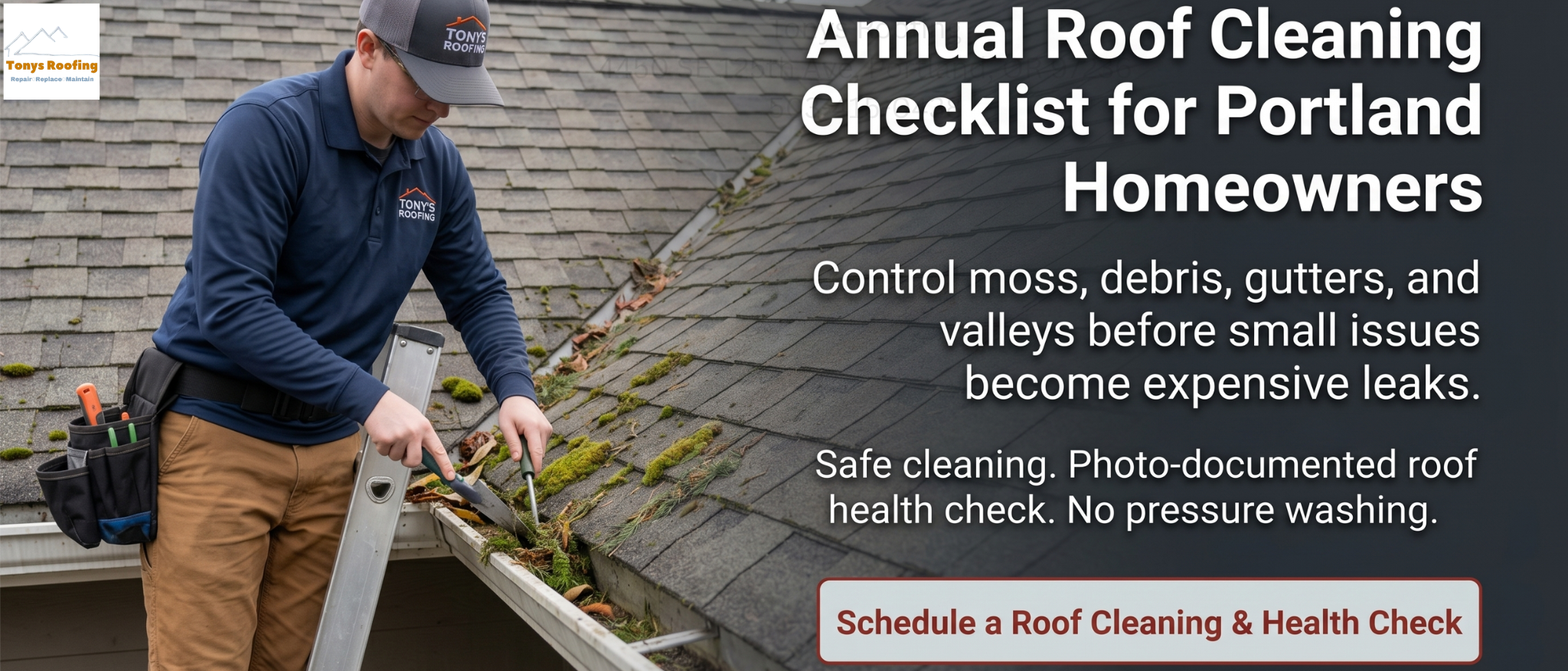
A worker removes moss from a house roof with tools. Text on image promotes annual roof cleaning and health checks for Portland homeowners.

Annual Roof Cleaning Checklist for Homeowners

Key Takeaways

  • In Portland, roof cleaning is about controlling moisture and debris, not just making shingles look pretty.
  • Gutters and valleys are the biggest “small issues” that turn into big leaks when they’re clogged.
  • Avoid pressure washing asphalt shingles—it frequently does more harm than good and can void warranties.
  • Moss is common; how much you have and what the roof looks like underneath matters more than whether it’s present at all.
  • The safest next step, if you’re unsure, is a roof cleaning plus photo‑documented health check so you can see, not guess, what your roof really needs.

Roof Cleaning Shouldn’t Mean Blasting Your Shingles

When most people hear “roof cleaning,” they picture someone with a pressure washer blasting moss and dirt off the roof. On asphalt shingles, that’s one of the fastest ways to shorten a roof’s life—not extend it.

In Portland, real roof cleaning is about moisture and debris control: keeping gutters and valleys flowing, keeping moss in check, and spotting small issues early so they never turn into major leaks.

You deserve honest guidance—not risky shortcuts.

Quick Answer: What “Roof Cleaning” Means (And Doesn’t Mean)

In plain English, proper roof cleaning means:

  • Managing debris (leaves, needles, branches) so water can flow freely
  • Controlling moss and algae before they lift shingles or trap long‑term moisture
  • Making sure gutters, downspouts, and valleys can move water off your roof quickly
  • Using the process to spot early warning signs (cracked vent boots, loose flashing, sagging areas)

It does not mean:

  • High‑pressure washing of asphalt shingles
  • Harsh chemicals that burn landscaping or degrade roofing materials
  • Walking on steep, wet, or mossy roofs without proper safety gear

A clean roof dries faster, sheds water better, and usually lasts longer in our climate.

Why Annual Roof Cleaning Matters More in Portland

Our roofs are under different pressure than in drier regions:

  • Long wet season – Persistent rain and high humidity from fall through spring keep materials damp and give moss and algae time to establish.
  • Tree-heavy neighborhoods – Fir needles and leaves collect on roofs and in gutters, holding moisture right where you don’t want it.
  • Moss thrives in shade – Shaded and north‑facing slopes dry last, and moss loves those cool, damp surfaces.
  • Clogged valleys and gutters back water up – Debris dams can push water sideways and under shingles, into underlayment and decking.

An annual cleaning and checkup is often the difference between routine maintenance and a surprise repair bill when the first big winter storm hits.

Annual Roof Cleaning Tasks: What, When, and Why

Information Table #1: Annual Roof Cleaning Tasks

Task When to Do It Why It Matters What It Helps Prevent
Clean gutters and downspouts At least twice a year (late fall and spring); more often under big trees. Keeps water moving off the roof edge instead of backing up under shingles or over fascia. Edge leaks, fascia/soffit rot, siding stains, and foundation water issues.
Clear valleys and roof edges 2–4×/year in tree‑heavy yards; after major windstorms. Valleys are “water highways”; debris here acts like a dam that pushes water sideways under shingles. Valley leaks, underlayment damage, and localized decking rot.
Monitor and treat moss/algae Year‑round observation; treatment every 1–3 years, depending on shade and growth rate. Moss holds moisture, lifts shingle edges, and accelerates shingle and decking wear. Premature shingle failure, leaks, and shortened roof lifespan.
Trim overhanging branches As needed; often late summer or fall when trees are more accessible. Reduces debris and shade and prevents branches from scraping granules off shingles. Heavy debris accumulation, moss growth, and mechanical shingle damage.
Schedule an annual pro inspection (with photos) Once a year, twice for older, shaded, or moss‑prone roofs. Catches hidden issues (flashing gaps, cracked vent boots, soft spots) before they become leaks. Expensive repairs, emergency leak calls, and surprise replacement decisions.

What You Can Safely Check vs. What Pros Should Handle

You don’t need to—and usually shouldn’t—do everything yourself. Here’s a simple breakdown.

Information Table #2: DIY Safe Checks vs. Pro Work

Item Safe for Homeowners? Best Handled by Pros Why
Ground‑level visual check (binoculars, from windows) ✅ Yes No fall risk; great way to spot debris piles, moss patches, and obvious damage.
Gutter cleaning on a single‑story, low‑slope home (with safe ladder use) ✅ Often, if you’re confident and the conditions are dry ✅ For multi‑story, steep, or difficult access Falls are a real risk; higher roofs and tricky access are better left to pros.
Valley clearing and debris removal on the roof surface ⚠️ Possibly on very low‑slope roofs only ✅ Yes Wet, mossy surfaces are slippery; it’s easy to crack shingles or slip.
Moss removal from shingle surfaces ⚠️ Light brushing on very low, safe sections only ✅ Yes Moss is easy to over‑scrub, and DIY methods often damage granules or lift shingles.
Pressure washing shingles ❌ No ❌ No Pressure washing strips granules, can force water under shingles, and often voids warranties.
Flashing and vent boot inspection/repair ❌ No ✅ Yes Requires close, on‑roof work and roofing know‑how; mistakes here commonly cause leaks.

Inline CTA: Not sure what you’re seeing from the ground—or what’s safe to do? Schedule a roof cleaning and health check, and we’ll walk you through it with photos.

Step‑by‑Step Annual Roof Cleaning Checklist

Think of this as your yearly rhythm. You don’t have to do it all in one day, but each step plays a role.

A) Safety First (Non‑Negotiable)

  • Never walk a steep, wet, or mossy roof without proper safety gear.
  • Avoid ladder work during rain, frost, or high winds.
  • If you don’t feel 100% confident on a ladder or roof edge, treat that as a hard stop—call a pro instead.

Your safety is worth more than any maintenance task.

B) From-the-Ground Checks (Safe Homeowner Actions)

Walk around your home and note:

  • Visible debris piles in valleys or lower edges
  • Gutters overflowing during rain or stained fascia that shows past overflow
  • Areas where moss patches are expanding from one year to the next
  • Any lifted shingles, wavy rooflines, or sagging spots
  • Downspout discharge – Is water actually flowing away from the house, or pooling at the base?

Take photos with your phone; they’re useful when talking with a roofer.

C) Drainage Cleaning (Lowest‑Risk, Highest Payoff)

If it’s safe to do so:

  • Clean gutters and downspouts on accessible sections—removing leaves, needles, and sediment.
  • After cleaning, run water from a hose into the gutters (if reachable) and watch from the ground:
    • Does water flow freely to the downspouts?
    • Are there any sags or overflows?

If your home is multi‑story, on a steep slope, or access is tricky, this step is a perfect candidate for a professional maintenance visit.

D) Debris Management on the Roof

For very low‑slope, easy‑access areas only:

  • Remove small branches and loose piles of debris that trap moisture.
  • Focus on valleys and edges, where debris does the most damage by blocking water flow.

Avoid dragging debris across shingles; lift and toss gently into a tarp or down to a safe spot, not onto walkways.

E) Moss and Algae Management (Do’s and Don’ts)

Do:

  • Watch for early growth—small green patches or dark streaks—so you can treat before it gets thick.
  • Use gentle, manufacturer‑recommended treatments applied with low pressure, ideally in cool, dry weather.
  • Consider preventive measures like zinc‑ or copper‑based treatments in high‑risk areas.

Don’t:

  • Don’t pressure wash asphalt shingles; it strips granules and can cause leaks.
  • Don’t use harsh chemicals without understanding how they affect landscaping, metal, and shingles.
  • Don’t aggressively scrape or wire‑brush moss; that often causes more damage than the moss itself.

Thick, well‑established moss is almost always a job for a professional who knows how to remove it without ruining the roof.

F) After Cleaning: What to Look For

Once gutters are clear and obvious debris is gone (by you or a pro), it’s time to assess the roof’s health:

  • Any exposed nails, popped fasteners, or missing shingles?
  • Cracked or pulled‑away vent boots around pipes?
  • Rusty or gapped flashing around chimneys, skylights, or along walls?
  • Persistent damp areas, dark stains, or sagging spots that don’t make sense?

These are your cues to schedule a professional inspection. Cleaning reveals hidden problems; it doesn’t fix them by itself.

Common Roof Cleaning Mistakes to Avoid

You’re trying to protect your home—these pitfalls just make it more expensive.

  • Pressure washing shingles
    Strips granules, forces water under shingles, and often voids manufacturer warranties.
  • Harsh, untested chemicals
    Strong bleach or other cleaners can burn plants, corrode metals, and damage roofing when misused.
  • Walking steep or wet roofs
    Moss and algae make shingles as slippery as ice; falls from roofs are a leading cause of serious injury in home maintenance.
  • Cleaning gutters but ignoring valleys
    Valleys carry more water than any single gutter; debris here is a major leak trigger.
  • “Caulk fixes everything” thinking
    Squirting sealant over problems instead of addressing flashing or material failure is a short‑term patch that often fails when you need it most.

We want you informed—not injured, and not paying twice.

When Cleaning Is Enough vs. When You Need Repair or Replacement

Cleaning is maintenance; repairs and replacement are about condition.

Cleaning is often enough when:

  • The roof is under ~15–20 years old and generally in good shape
  • Moss and algae are light to moderate, with no visible shingle damage
  • Gutters and valleys were just neglected and now flow well after cleaning
  • No active leaks or interior stains are present

Repairs or replacement deserve a closer look when:

  • Shingles are curled, cracked, or bald across larger areas
  • Moss has visibly lifted shingles, and water is getting under them
  • You feel soft spots when walking (or an inspector does), or see sagging sections
  • You have recurring leaks or stains that return after prior “patches”
  • The roof is clearly at end‑of‑life (often 20–25+ years here), and small issues keep popping up

A trustworthy roofer will show you photos of these conditions and explain your options, not jump straight to “new roof” if cleaning or repairs will reasonably extend the roof’s life.

FAQs: Annual Roof Cleaning in Portland

How often should I clean my roof in Portland?

For most homes:

  • Gutters/downspouts: at least twice a year (late fall and spring), more under heavy tree cover.
  • Roof surface (debris/moss/algae): visually check several times a year; plan professional cleaning/treatment every 1–3 years depending on shade and growth.
  • Full roof inspection: once a year; twice for older or heavily shaded roofs.

Is moss removal worth it, or just cosmetic?

It’s worth it. Algae streaks are mostly cosmetic early on, but moss is widely recognized as damaging because it holds water and lifts shingles. Left alone, it shortens roof life and can lead to leaks.

Can I pressure wash my roof safely?

For asphalt shingles, the general answer is no. Pressure washing removes protective granules, can damage shingles, and often voids warranties. Gentle, low‑pressure treatments are the recommended approach.

Do roof cleaning treatments harm landscaping?

They can if used incorrectly. Professional treatments are typically formulated and applied with plant protection and thorough rinsing in mind. If you DIY, carefully follow product instructions and pre‑wet/cover sensitive plants.

Are zinc strips or preventative treatments worth it?

Preventive measures like zinc/copper‑based treatments can help slow moss regrowth and are commonly recommended in moss‑prone regions like ours. They’re most effective as part of a broader maintenance plan (debris control, inspections), not a one‑time fix.

How do I know if moss means damage underneath?

Signs that damage may already be present:

  • Shingles crack, crumble, or come off easily when moss is dislodged
  • Roof feels soft or spongy in mossy areas (as reported by a pro)
  • Interior stains or leaks line up with heavy moss zones

A professional inspection with photos from both the roof and attic sides is the best way to know for sure.

What’s the best time of year to clean a roof?

Late spring through early fall is ideal:

  • Roofs are generally drier
  • Treatments work better and dry correctly
  • Work is safer and more comfortable for crews

Gutter and valley cleanings may need to happen more often, especially in late fall as leaves and needles drop.

Should I clean the roof or replace it if it’s older?

If your roof is:

  • Relatively old (20–25+ years) and showing widespread cracking, curling, or bald spots, cleaning won’t add much life—it might just buy a short cosmetic improvement.
  • Structurally sound but dirty/mossy, cleaning and targeted repairs can be a smart bridge before replacement.

An inspection that includes age, condition, and photos is key to making that call with confidence.

Can roof cleaning extend roof life?

Yes—especially in climates like Portland’s, where debris and moss accelerate wear. Keeping water moving, reducing moss load, and catching early issues almost always extends useful roof life compared to a “wait until it leaks” approach.

Ready for a Safe, Straight‑Forward Next Step?

You don’t have to figure this out alone—or feel like you’re being sold at every turn.

Get an Honest Roof Evaluation (No Pressure)

  • Family‑owned, serving Portland for decades
  • Licensed & insured
  • Photo‑based findings + plain‑English explanations
  • We’ll tell you if a repair is enough—and if things look good, we’ll say that too

Request My Free Roof Replacement Quote


When you’re ready to take the next step, give us a call. We’re here to help.

Tony’s Roofing Contractors
(503) 415-0438

A roofing professional shows a clipboard to a woman outside a house, with text promoting the benefits of hiring local roofing contractors.

Why Local Roofers Are Safer Than Out-of-State Contractors

Key Takeaways

  • The biggest risk with out‑of‑state or storm‑chaser roofers is lack of accountability, not speed.
  • If a contractor can’t be found later, their warranty may be worthless—no matter what it says on paper.
  • Always verify license, insurance, local address, and references, and insist on a detailed written scope.
  • Avoid door‑to‑door pressure, “sign today” discounts, and vague “free roof” promises.
  • The safest next step is a photo‑documented inspection from a local roofer who will still be here years from now to answer the phone.

Accountability Matters More Than Promises

After a big storm, it’s normal to feel stressed when you see missing shingles, loose flashing, or a damp spot on the ceiling. That’s exactly when out‑of‑state “storm chaser” contractors show up—promising fast fixes, “free roofs,” and deals that expire today.

The biggest risk usually isn’t the damage you can see. It’s hiring someone who disappears once you’ve paid, leaving you alone with any problems that show up later.

You deserve a roofer who treats you like a neighbor—not a transaction.

Quick Answer: Why Local Is Safer

Local roofers are safer because they:

  • Have local licenses, insurance, and a physical presence that’s easy to verify
  • Rely on long‑term reputation, reviews, and referrals instead of one‑time storm work
  • Are still here years later to honor warranties, fix issues, and answer the phone

Out‑of‑state contractors may or may not do good work, but if you can’t find them after the storm season ends, their promises and “lifetime” warranties are just paper.

Why Out-of-State Contractors Show Up (And When It’s Risky)

When storms hit, demand for roof repairs and replacements spikes overnight.

  • Storm damage = sudden need – Homeowners want fast help, often all at once.
  • Traveling crews follow storms – Some are legitimate companies; many are short‑term outfits set up to capture quick insurance work.
  • The core issue is accountability – If they leave the area after the work is done, it’s hard or impossible to get warranty work, service calls, or even a returned phone call later.

Geography itself isn’t the enemy; disappearing contractors are. If a company can’t be found easily a year from now, you’re carrying all the long‑term risk.

Local vs. Out-of-State Roofers: Risk Comparison

Information Table #1: Local vs Out-of-State Roofer

Category Local Roofer (Accountable) Out‑of‑State / Storm Chaser Risk
Warranty support More likely to be reachable, with an office and staff nearby to handle issues years later. May be gone once storm work dries up; hard to get callbacks or warranty help.
Licensing & compliance Easy to verify through state and local registries; long‑term track record. License may be new, from another state, or hard to verify; sometimes borrowed or misrepresented.
Insurance & liability Easier to obtain and confirm up‑to‑date insurance certificates with local agents. Coverage can be vague, expired, or held by a different entity than the one on your contract.
References Local jobs you can drive by; homeowners you can actually call. References may be out‑of‑state, unverified, or generic “sample” photos.
Communication style Relationship‑driven; depends on reviews, referrals, and repeat business. Often transaction‑driven and heavily scripted, focused on fast sign‑ups before moving on.
Pricing approach More likely to present a detailed scope and realistic pricing based on local costs. May lead with low initial bids, then rely on add‑ons, supplements, or scope changes later.
Knowledge of Portland roofs Familiar with moss, moisture, wind‑driven rain, and tree debris challenges in our climate. Often apply generic methods that don’t account for local conditions or common failure points.
Long‑term accountability “Still here tomorrow” — local address, local suppliers, local reputation. Company names, phone numbers, and crews may change frequently; hard to track accountability.

How to Verify Any Contractor (Local or Not)

Whether a roofer is around the corner or from another state, the verification steps are the same. Local pros just tend to pass them more easily.

Information Table #2: Contractor Verification Checklist

What to Verify What to Ask For What “Good” Looks Like
License Oregon CCB license number; name the license is under. Active license matching the company name, correct classification, and clean history in the Oregon CCB search.
Insurance Certificate of insurance sent directly from their agent (not just a photocopy). Current general liability and (ideally) workers’ comp with limits appropriate for roofing.
Local address Physical office or shop location, not just a PO box. Address that exists in Google Maps/online, consistent across the website, state records, and paperwork.
References 2–3 recent local homeowners you can call. Reachable people who confirm the company’s work and communication, ideally within your broader area.
Written scope Line‑item estimate with scope, materials, flashing, ventilation, decking policy, and cleanup. Detailed, plain‑English document that another roofer could follow; no one‑line “replace roof” quotes.
Warranty Written terms for workmanship and materials. Clear durations, what’s covered, and who to contact if there’s an issue; not just “lifetime” without details.
Change‑order policy Explanation of what happens if hidden damage is found. Written process: photos, explanation, and homeowner approval before extra work is done.

Inline CTA: Want a local pro to confirm storm damage and walk you through this checklist? Schedule a free, photo‑documented inspection before you sign anything.

Common Storm-Chaser Tactics and Red Flags

You don’t have to memorize every trick—just know the patterns. Common warning signs include:

  • “Free roof” or “insurance will pay for everything” promises
    No contractor can guarantee coverage before your insurer reviews a claim.
  • High‑pressure door‑to‑door sales after storms
    Showing up uninvited with clipboards and insisting your roof is “urgent” before they’ve really inspected it.
  • “Sign today” discounts or expiring offers
    Urgency is a classic pressure tactic; legitimate estimates don’t evaporate overnight.
  • Asking to be listed as your contractor on the insurance claim form immediately
    They may try to “lock in” control of your claim before you have time to compare bids.
  • Unwilling to provide license, insurance certificate, or local references
    Or they dodge the question, saying “we’ll take care of everything.”
  • Vague company identity
    Changing names, no real online presence, or only generic website content with no local projects.
  • No clear written scope
    One‑line estimates, no mention of flashing, ventilation, decking, or cleanup.

If you’re feeling rushed or confused, that’s a sign to pause.

Why “Still Here Tomorrow” Matters So Much

A roof isn’t a one‑day relationship. What happens after the crew leaves matters just as much as day one.

Local, established roofers are better positioned to:

  • Stand behind workmanship warranties – If something small shows up in the first few years, you know who to call.
  • Help with warranty paperwork – Registering enhanced manufacturer warranties and advising you on how to keep them valid.
  • Handle repairs and maintenance later – From a loose shingle to a flashing tweak, you’re not calling a 1‑800 number hoping someone still answers.
  • Respond to future storms – They’re here for the next storm, too—not just this one.

If a contractor won’t be around to see how their own work holds up in Portland’s climate, they have less incentive to do it right.

What to Do if Someone Knocks on Your Door After a Storm

You don’t have to be confrontational. Use a simple script and process:

  1. Stay calm and don’t sign anything at the door.
    Thank them for stopping by and let them know you’re collecting information.
  2. Ask for their CCB license number and insurance certificate.
    A legitimate contractor will have this handy and won’t be offended by the question.
  3. Ask for a local address and 2–3 recent local references.
    Write them down; don’t just accept “we’ve done lots of work in your area.”
  4. Tell them you’ll review everything and get multiple estimates.
    “We always compare a couple of quotes before deciding. We’ll reach out if we’d like an estimate.”
  5. Schedule a photo‑documented inspection with a local roofer you choose.
    Ideally, someone with established roots and a clear estimating process.
  6. Compare quotes using a checklist.
    Make sure you’re looking at scope and details—not just the lowest number.

If a door‑knocker pushes back against this process, that’s your answer.

FAQs: Local vs Out-of-State Roofers

Are all out-of-state roofers “storm chasers”?

No. Some established companies do travel for large projects. The concern is whether they maintain a presence and support in the area after the initial rush of work is finished. If they can’t be easily contacted later, you carry more risk.

How do I verify a roofer’s license and insurance in Oregon?

  • Look up their CCB license number on the Oregon Construction Contractors Board website to confirm status and classification.
  • Ask their insurance agent to email you a certificate of insurance directly.
  • Confirm that the company name on the license, insurance, and contract all match.

Will insurance pay for storm damage to my roof?

In many cases, yes—if damage is sudden and storm‑related—but details depend on your policy, deductible, and insurer. It’s always best to call your insurance agent directly before signing anything, and be cautious of contractors who promise coverage they can’t guarantee.

What should I do if I already signed something with a door-knocker?

  • Read what you signed to see if it’s a contingency agreement, authorization to represent you to insurance, or a full contract.
  • If you’re uncomfortable, contact an attorney or consumer protection agency about your options.
  • You can still schedule a local inspection to get a second opinion on the roof’s actual condition.

What’s a reasonable deposit and payment schedule?

Practices vary, but many reputable roofers:

  • Take a modest deposit to secure scheduling and materials
  • Collect the balance upon substantial completion or in clear stages

Avoid paying most or all of the money upfront.

How can I tell if a quote is missing important items?

Use a comparison checklist and look for missing details on:

  • Tear‑off layers
  • Underlayment and flashing
  • Vent boots and ventilation plan
  • Decking allowance/change‑order policy
  • Cleanup and warranty details

Why do storm chasers push people to file claims quickly?

Storm‑chaser models often depend on high claim volume and fast sign‑ups before homeowners have time to compare options or calm down. Pushing urgent claims and same‑day signatures is part of that playbook.

What makes a local roofer more accountable?

  • Local reputation and reviews they rely on for future business
  • Relationships with local suppliers and inspectors
  • The fact that they’ll likely drive by their past jobs for years—and see how their work holds up
  • You can walk into their office or shop if needed

Ready for a Safe, Straight‑Forward Next Step?

You don’t have to figure this out alone—or feel like you’re being sold at every turn.

Get an Honest Roof Evaluation (No Pressure)

  • Family‑owned, serving Portland for decades
  • Licensed & insured
  • Photo‑based findings + plain‑English explanations
  • We’ll tell you if a repair is enough—and if things look good, we’ll say that too

Request My Free Roof Replacement Quote

When you’re ready to take the next step, give us a call. We’re here to help.

Tonys Roofing Contractors

(503) 415-0438

A man and woman review roofing estimate documents at a kitchen table, with a tablet and papers listing flashing, ventilation, and warranty details.

What’s Included in a Professional Roof Estimate?

Key Takeaways

  • A professional roof estimate is written, detailed, and specific—it tells you exactly what will be done, with what materials, and under what conditions.
  • Quotes vary because of scope, materials, roof complexity, and how they handle hidden repairs, not just contractor markup.
  • The items most often missing in “cheap” bids are the ones that prevent leaks: flashing, underlayment quality, vent boots, decking allowance, and ventilation.
  • Use a simple checklist or table to compare quotes apples‑to‑apples, instead of just looking at the bottom line.
  • The safest next step is a photo‑documented evaluation with a clear written scope—no pressure—so you can understand your options before you decide.

A Roof Estimate Shouldn’t Feel Like a Mystery

If you’ve ever laid two roofing quotes side by side and thought, “Why are these so different—and which one is missing something?”, you’re not alone.

A lot of homeowners get burned because one bid looks cheaper… until the missing items show up later as “extra charges” or, worse, as leaks a few years down the road.

You deserve clear answers—not pressure.

This guide walks through what a professional roof estimate should include, what vague or “too cheap” bids often leave out, and how to compare quotes fairly so you can choose with confidence.

Quick Answer: What a “Professional Roof Estimate” Really Means

A professional roofing estimate is:

  • Written and specific – not just “replace roof: $X.”
  • Clear about scope + materials + workmanship – so another pro could do the same job from that document.
  • Upfront about variables – like what happens if bad decking is found or extra work is needed.
  • Explicit about warranties and cleanup – including what’s covered, for how long, and how your property will be protected.

If a quote doesn’t do those things, it’s not really letting you compare “apples to apples” with more detailed bids.

Why Roofing Estimates Vary (Even for the “Same” Job)

Not every roof—or roofing company—is dealing with the same puzzle. Key reasons quotes differ include:

  • Roof size and shape – Roofs are priced by area (squares or square feet), plus a waste factor for cuts at hips, valleys, and ridges.
  • Pitch and complexity – Steeper, higher, or more cut‑up roofs (valleys, dormers, skylights) require more labor, safety setup, and time.
  • Tear‑off scope – Removing one layer vs. two+ layers of old roofing changes labor, disposal, and how well new materials will perform.
  • Decking/sheathing condition – Roofs with known soft spots or prior leaks need allowances for replacing bad wood.
  • Flashing and penetrations – Quotes that include full flashing and vent boot replacement will cost more—but also prevent more leaks—than bids that only mention “seal existing flashing.”
  • Underlayment and components – Synthetic vs. felt underlayment, ice/water barrier usage, starter and ridge products, ventilation upgrades, etc., all affect price and performance.
  • Access and logistics – Multi‑story access, tight driveways, landscaping protection, and disposal logistics can change labor and equipment costs.

The goal isn’t to chase the lowest number—it’s to understand what’s covered so you can see which quote actually protects your home best.

The Core Checklist: What Every Professional Roof Estimate Should Include

Think of a good estimate in sections. You should see clear, written detail for each of these.

A. Scope of Work

  • Repair vs. replacement – Is this a full reroof, partial section, or targeted repair?
  • Areas included – Main house, garage, porch, additions, flat sections—all clearly described.
  • Tear‑off details – How many layers are being removed? Is it a full tear‑off or an overlay (second layer)?
  • Disposal and cleanup – Who is hauling away old materials, and how is site cleanup handled.

B. Materials (Specific, Not Generic)

You should see brand names and product lines—not “30‑year shingle” and “felt.”

A solid estimate calls out:

  • Shingle or main roofing material – Manufacturer, product line, and sometimes color.
  • Underlayment – Synthetic vs. felt; ice/water barrier locations (eaves, valleys, around penetrations) where appropriate to the climate.
  • Flashing scope – Chimneys, sidewalls/headwalls, valleys, skylights, pipe flashing, and whether it’s replaced or reused.
  • Vent boots/pipe seals – Replacing old boots, not just “reseal.”
  • Ridge caps and starter – Purpose‑made ridge and starter strips vs. cut‑up three‑tabs.
  • Fasteners – Nail type, coating, and nailing pattern, especially for high‑wind or manufacturer requirements.

C. Decking / Sheathing Plan

This is where many “cheap” quotes are vague.

A professional estimate explains:

  • How will the decking be evaluated once the old roof is removed.
  • Allowance or per‑sheet pricing for replacing rotten or damaged sheathing.
  • A simple change‑order policy: how they’ll communicate and get your approval before adding cost.

D. Ventilation / Attic Considerations

Good roofers don’t ignore how your roof “breathes.”

A strong estimate may include:

  • Notes on current intake and exhaust ventilation (soffit vents, ridge vents, box vents) and whether it meets modern standards.
  • Any recommended upgrades or corrections, especially in older Portland homes, where ventilation is often undersized.
  • A clear statement of what ventilation is unchanged, so you know what is and isn’t included.

E. Timeline and Logistics

You should know:

  • Expected start window and approximate project duration.
  • How weather delays are handled (especially important in Portland’s wet season).
  • Property protection plan – tarps, landscaping protection, parking, and access.
  • Daily cleanup and nail sweep expectations.

F. Warranty Breakdown

This is often a point of confusion, so good estimates spell it out:

  • Manufacturer’s material warranty – what line of shingle/roofing system, duration, and whether it’s a basic or enhanced system warranty.
  • Contractor’s workmanship warranty – how many years of coverage for installation‑related leaks or defects.
  • Any requirements to keep coverage valid (maintenance, ventilation, no improper alterations, etc.).

G. Payment Terms

Finally, you should see:

  • Deposit amount and timing
  • Any progress payments or final payment triggers
  • Clear statement on what’s included in the price and what would require a change order

Estimate Line Items: Plain‑English Glossary

Information Table #1: What Line Items Mean and Why They Matter

Estimate Line Item What It Means Why It Matters
Tear‑off / removal How many layers of old roofing will be removed before installing the new system. Full tear‑off lets the contractor inspect decking, fix hidden issues, and install the new roof to spec; overlays can hide problems and affect warranties.
Underlayment The water‑resistant barrier installed under shingles or main roofing material. It’s a major leak‑prevention layer—especially at eaves, valleys, and penetrations—and affects long‑term performance.
Flashing Metal or membrane pieces that waterproof transitions at chimneys, skylights, walls, valleys, and edges. Most leaks start here. If a quote skimps on flashing work, you may be paying for another leak repair soon.
Vent boots / pipe flashing Seals around plumbing pipes and other roof penetrations. These are a very common leak source once rubber ages; replacing them during reroofing prevents many future issues.
Decking allowance The policy and pricing for replacing rotten or damaged wood under the roofing. Without an allowance or per‑sheet price, you’re vulnerable to big surprise add‑ons once the old roof is removed.
Ventilation The plan for intake (soffits) and exhaust (ridge/box vents) airflow through the attic. Proper ventilation extends roof life and is often required for manufacturer warranty coverage.
Cleanup / nail sweep Debris removal, dumpster, and magnet sweep for nails after the job. Reflects professionalism and safety for your family, pets, and tires.
Warranty Details of material and workmanship coverage, including duration and what’s covered or excluded. Tells you who stands behind the work, for how long, and for what kinds of issues.

Apples‑to‑Apples Quote Comparison Checklist

When you’re looking at 2–3 estimates, use a simple table to see who is (and isn’t) including key items.

Information Table #2: Quote Comparison Grid

(Fill in “Yes/No” or details for each contractor.)

Scope Item Contractor A Contractor B Contractor C
Full tear‑off (how many layers?)
Underlayment type (synthetic vs. felt, ice/water where?)
Flashing replacement scope (chimneys, walls, valleys, skylights)
New vent boots/pipe flashing included
Decking allowance / per‑sheet pricing clearly stated
Ventilation plan (intake + exhaust addressed)
Cleanup + magnet nail sweep outlined
Workmanship warranty length (years)
Manufacturer warranty type (basic vs. system/enhanced)
Timeline + communication plan included

If one bid looks much cheaper but has a lot of blanks in this kind of table, that’s a red flag.

Want a quote that checks all these boxes—clearly? Request a free, detailed estimate that spells it out in writing.

What’s Commonly Missing in Cheap or Vague Quotes (Red Flags)

Watch out for:

  • One‑line scopes
    “Replace roof” with no mention of tear‑off, layers, underlayment, flashing, or ventilation.
  • No flashing scope
    If it just says “reuse existing flashing” with no condition notes, you may be buying new shingles over old problem areas.
  • No decking plan
    If bad wood is found, how is it charged? If the quote doesn’t say, surprises are likely.
  • No mention of ventilation
    Good roofers at least note existing vents, and great ones propose improvements when needed.
  • No cleanup plan
    If cleanup and magnet sweep aren’t mentioned, they may be an afterthought.
  • “Lifetime warranty” with no detail
    Without clarity on manufacturer vs. workmanship, “lifetime” language can be misleading.
  • High‑pressure or “today only” pricing
    Urgency tactics can be a way to get you to sign before you notice what’s missing in the scope.

We want you protected—even if you don’t hire us.

Example of a “Good” Roof Estimate Structure

You don’t need exact pricing here—just the structure to look for. A strong estimate typically includes:

  1. Summary & roof condition notes
    Brief description of what the inspection found and what the proposal addresses.
  2. Scope of work
    Clear statement of whether it’s a full replacement or repair; areas included; tear‑off details.
  3. Materials list
    Specific products for shingles (or other roofing), underlayment, flashing, vents, ridge, starter, and fasteners.
  4. Ventilation/attic notes
    Any recommended changes or confirmation that the current setup is being maintained.
  5. Decking policy & allowances
    How bad wood is handled financially, with per‑sheet or allowance amounts.
  6. Timeline & logistics
    Start window, approximate duration, property protection, and cleanup plan.
  7. Warranty details
    Manufacturer and workmanship coverage, with durations and any key conditions.
  8. Payment terms & change‑order rules
    Deposit, progress payments, and how unexpected conditions are communicated and approved.

If an estimate follows that basic outline, you’re getting something you can actually judge and compare.

FAQs: Professional Roof Estimates in Portland

Why are roofing estimates so different in Portland?

Roofs here vary widely in age, complexity, and exposure to moss and debris, and contractors make different assumptions about tear‑off, flashing work, decking repairs, and ventilation. Some quotes include full system upgrades; others only cover minimums—so the scope, not just the price, is different.

Can a roofer estimate accurately without getting on the roof?

A basic ballpark might be possible from the ground, but a reliable estimate for repair or replacement should involve walking the roof (when safe), checking flashing, measuring accurately, and often inspecting the attic. Without that, key issues and costs can be missed.

What is a decking allowance and why does it matter?

Decking (sheathing) is the wood under your shingles. An allowance or per‑sheet price tells you how damaged wood will be handled and billed if it’s discovered during tear‑off. Without it, you’re vulnerable to large, unplanned add‑ons.

Should flashing always be replaced during replacement?

In most full replacements, replacing key flashings (chimneys, sidewalls, valleys, pipe flashings) is best practice. Re‑using old flashing may save a little now but often leads to leaks sooner, especially in a wet, wind‑driven climate like Portland’s.

What’s a reasonable deposit for roofing work?

Industry norms vary by region, but many reputable contractors ask for a modest deposit with the balance due upon substantial completion or in staged payments. Extremely large upfront payments can be a red flag; always make sure terms are in writing.

How do change orders work if hidden damage is found?

A professional estimate should say that if hidden damage is discovered, the contractor will:

  1. Document it with photos.
  2. Explain the issue and options.
  3. Provide pricing and get your approval before proceeding.

That’s what protects you from “surprise” charges.

What’s the difference between manufacturer and workmanship warranties?

  • Manufacturer (material) warranty – covers defects in shingles or roofing materials, usually prorated over time.
  • Workmanship warranty – covers installation errors and labor; this is what helps if something leaks because it was installed incorrectly.

Both should be explained in your estimate.

How do I tell if a quote is missing important items?

Use the comparison checklist above and look for blanks around:

  • Flashing replacement
  • Underlayment type and ice/water barrier
  • Decking allowance
  • Ventilation plan
  • Cleanup and nail sweep
  • Warranty details

If you have to ask, “Is that included?” several times, the quote may not be as complete as it looks.

Ready for a Safe, Straight‑Forward Next Step?

You don’t have to figure this out alone—or feel like you’re being sold at every turn.

Get an Honest Roof Evaluation (No Pressure)

  • Family‑owned, serving Portland for decades
  • Licensed & insured
  • Photo‑based findings + plain‑English explanations
  • We’ll tell you if a repair is enough—and if things look good, we’ll say that too

Request My Free Roof Replacement Quote

When you’re ready to take the next step, give us a call. We’re here to help.

Tonys Roofing Contractors

(503) 415-0438

1 2 3 6
CALL: 503-415-0438