Key Takeaways
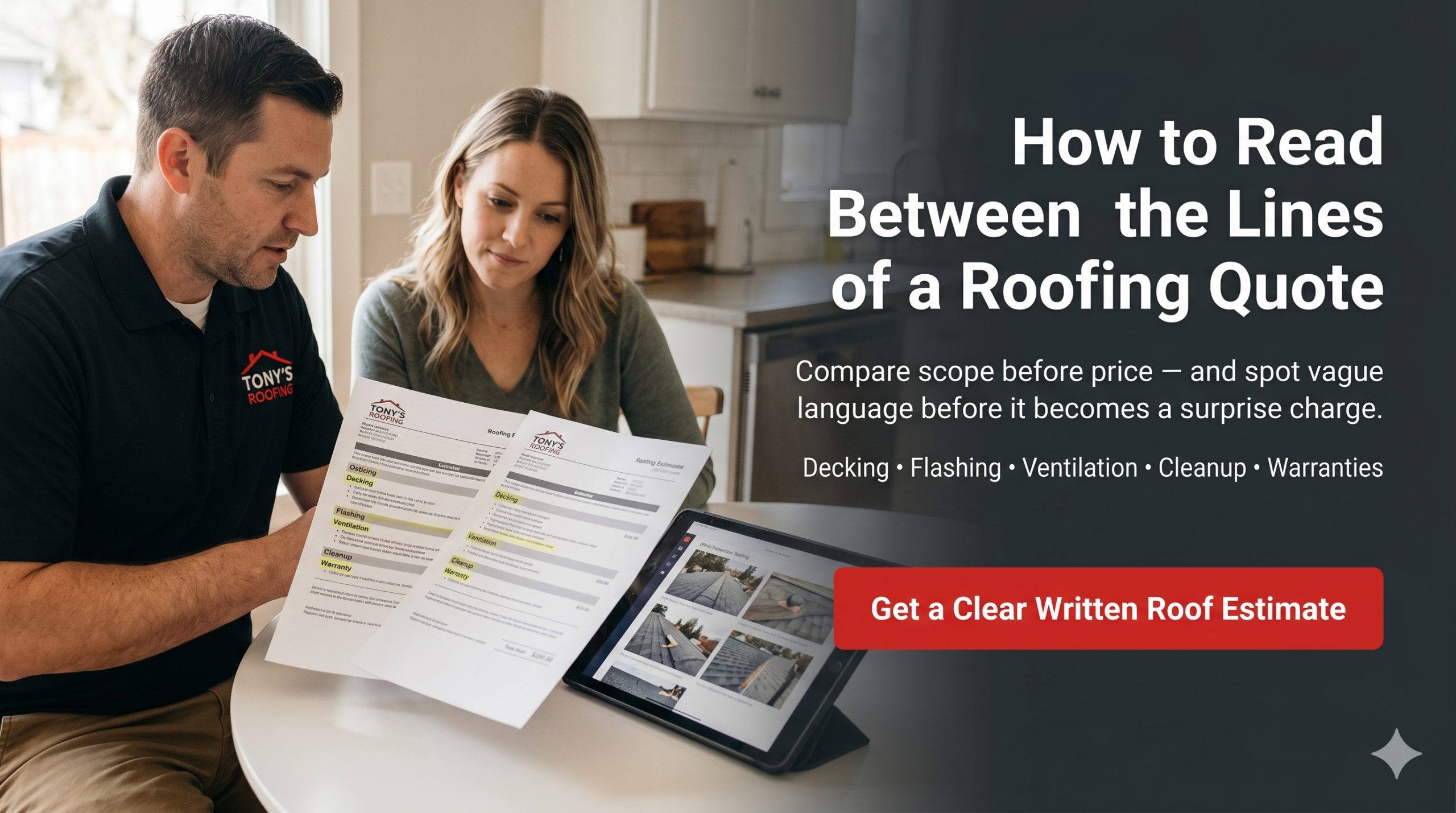
- Roofing quotes vary mainly because the scope varies—compare the scope before the price.
- Vague phrases often hide future add‑ons, especially around decking, flashing, ventilation, and cleanup.
- A trustworthy roofer documents your roof with photos, uses a clear written scope, and answers questions without pressure.
- Always get warranties in writing and understand what voids them—especially ventilation and improper alterations.
- If you want clarity, ask for a photo‑documented evaluation and a written scope so you can compare quotes confidently.
You Deserve Clarity, Not Confusion
If two roof quotes are thousands of dollars apart, it usually isn’t because one company is “honest” and the other is “greedy.” It’s usually scope—what’s included, what’s skipped, and what’s quietly left as a “we’ll see once we start” item.
The problem is when that scope is vague—because that’s where surprise costs and corner‑cutting live.
This guide is your roofing quote decoder so you can see what’s really on the table, compare bids fairly, and choose based on value—not just the lowest number.
You deserve clear answers, not pressure.
Quick Answer: Why Roofing Quotes Vary So Much
Most price differences come down to:
- Roof size, pitch, and complexity – Steeper, taller, and more cut‑up roofs (valleys, dormers, skylights) take more labor and materials.
- Tear‑off and disposal – One layer vs. two+ layers, and whether full tear‑off is included.
- Decking repairs – Whether replacing rotten wood is priced clearly or left open‑ended.
- Flashing and penetrations – Full replacement vs. “reuse existing” around chimneys, walls, skylights, and vents.
- Underlayment and components – Synthetic vs. felt, where ice/water barrier is used, starter and ridge products, fasteners.
- Ventilation – Whether intake and exhaust are evaluated and upgraded or ignored.
- Cleanup and warranties – How thoroughly the cleanup is done and how long the workmanship is backed.
Compare scope first, price second. The cheapest quote that skips key protections is rarely the best deal.
The Roofing Quote Decoder: What Phrases Really Mean
Quotes are full of short phrases that sound fine—but hide important details. Here’s how to translate them.
Information Table #1: Roofing Quote Decoder
| Quote Phrase You’ll See | What It Often Means | Questions to Ask |
| “Replace roof as needed” | Scope may be loosely defined; could just mean shingles, not full system. | “Exactly what will you replace—shingles only, or underlayment, flashing, vents, and ridge too?” |
| “Decking repairs if necessary” | Decking (sheathing) work is open‑ended and may be priced after tear‑off. | “What’s the per‑sheet cost for bad wood? Is there an allowance included?” |
| “Standard flashing” | Might mean “reuse most flashing, replace only if obviously bad.” | “Which flashings are you replacing—chimneys, wall intersections, skylights, valleys, pipe flashings?” |
| “Cleanup included” | Could be minimal cleanup; no detail on nails or debris. | “Do you include a magnet nail sweep and daily cleanup? How thorough is it?” |
| “Lifetime warranty” | Could be marketing shorthand; details might be buried or limited. | “Is this a manufacturer or workmanship warranty? How long is each, and what voids it?” |
| “Ice & water shield as required” | Locations (eaves, valleys, around penetrations) may not be specified. | “Where exactly will you install ice & water shield—eaves, valleys, around chimneys/skylights?” |
| “Ventilation per code” | May mean “no changes” if code minimum is already met. | “Are you evaluating intake and exhaust balance and making recommendations, or leaving it as is?” |
| “Materials: shingles” | Brand and product line may be missing. | “Which manufacturer and product line are you using? What underlayment will go under them?” |
If a contractor struggles to answer these calmly and clearly, that’s a sign.
Apples-to-Apples Scope Checklist
Use this table to compare 2–3 quotes side by side. Fill in details; blanks show you where something might be missing.
Information Table #2: Scope Comparison Grid
| Scope Item | Contractor A | Contractor B | Contractor C |
| Tear‑off (how many layers?) | |||
| Disposal included (dumpster, haul‑off) | |||
| Underlayment type (synthetic vs. felt) | |||
| Ice/water barrier locations (eaves/valleys/penetrations) | |||
| Flashing replacement scope (chimneys, walls, valleys, skylights) | |||
| New vent boots/pipe flashings included | |||
| Ridge cap & starter strip type | |||
| Decking allowance / cost per sheet | |||
| Ventilation plan (intake + exhaust addressed?) | |||
| Cleanup + magnet nail sweep described | |||
| Workmanship warranty length (years) | |||
| Manufacturer warranty (basic vs. system/enhanced) | |||
| Timeline + communication plan (start/duration) |
If one quote looks cheapest but leaves multiple cells blank here, it’s not really comparable.
Hidden Cost Traps Inside Roofing Quotes
You’re not trying to become a roofer—you just want to avoid surprises. Here are the main “gotchas” to watch for:
1. Decking Without a Clear Policy
Phrases like “decking repairs as needed” with no per‑sheet price or allowance can open the door to large, last‑minute add‑ons.
Ask:
- “What’s your per‑sheet price for replacing bad wood?”
- “Roughly how many sheets do you typically replace on roofs like mine?”
2. Flashing Left Vague or Reused
If flashing isn’t clearly called out, it often means “reuse as much as possible.” That’s risky around chimneys, walls, and skylights—where most leaks begin.
Ask:
- “Are you replacing all critical flashings, or only what’s visibly bad?”
3. Vent Boots Not Included
Old rubber pipe boots are a leading cause of “mystery leaks.” Skipping them saves a little today and costs more later.
Ask:
- “Will all vent boots/pipe flashings be replaced as part of this job?”
4. Ventilation Ignored
“Per code” sometimes means “we’re not changing anything.” Poor ventilation can shorten roof life and affect warranty coverage.
Ask:
- “Will you evaluate my intake and exhaust and recommend changes if needed?”
5. Change Orders Without a Clear Process
If the quote doesn’t explain how unexpected findings are handled, you could face big surprise costs during the job.
Ask:
- “If you find hidden damage, how will you document it and get my approval before adding cost?”
6. Ultra-Low Bid That Relies on Upsells
Some contractors bid low on visible items, then depend on change orders, supplements, or rushed decisions once the roof is opened up.
Ask:
- “Is there anything you expect could add cost later? How do you handle that?”
We’re not telling you who to hire—we’re helping you protect your home.
Red Flags vs. Green Flags in Roofing Quotes
Red Flags (Pause and Question)
- High‑pressure tactics – “Sign today to get this price,” or “We can only hold this discount if you decide now.”
- Vague, one‑line scopes – “Replace roof: $X” with no materials, flashing, or decking detail.
- Unwilling to show a license/insurance certificate or documents that don’t match the company name on your quote.
- No photos or inspection notes – They haven’t documented what they’re basing the quote on.
- Evasive when you ask questions – You feel rushed or talked in circles instead of being clearly answered.
Green Flags (You’re on the Right Track)
- Photo‑documented findings – Photos of your actual roof, along with written notes.
- Clear, line‑item scope – You can see what’s happening with tear‑off, underlayment, flashing, decking, vents, and cleanup.
- Written change‑order policy – They explain how unexpected issues will be handled and approved.
- Encourages questions and comparisons – They’re happy to explain differences vs. other quotes.
- Reasonable deposit and terms – Modest deposit, balance due on completion or clearly defined milestones.
- Warranties in writing – With clear durations and who to call if there’s a problem.
What a “Good Quote” Looks Like (Outline Example)
You don’t need to see exact prices here—just structure. A strong roofing quote typically includes:
- Roof condition summary
Short notes on what the inspection found (age, layers, visible damage, areas of concern). - Scope of work
- Repair vs. full replacement
- Areas included (house, garage, additions)
- Tear‑off details (how many layers)
- Materials list
- Shingle or main roofing: brand + product line
- Underlayment type and any ice/water barrier locations
- Flashing scope and materials
- Vent boots, ridge caps, starter, and fasteners
- Flashing + ventilation notes
- Which flashings will be replaced
- Ventilation/attic recommendations or confirmation of status
- Decking policy
- How bad wood is identified
- Allowance or per‑sheet pricing
- How you’ll be notified
- Timeline & logistics
- Estimated start window and duration
- Weather contingencies
- Property protection and daily cleanup plan
- Cleanup plan
- Dumpster placement
- Debris removal
- Magnet nail sweep specifics
- Warranty details
- Manufacturer warranty type and length
- Workmanship warranty length and coverage
- Payment schedule
- Deposit amount
- Progress or final payment triggers
- Change‑order policy
- How unexpected items are documented, priced, and approved
If a quote follows that kind of outline, you have something you can truly compare and trust.
FAQs: Reading Roofing Quotes in Portland
Why are roofing quotes so different in Portland?
Because roofs here differ in age, complexity, moss/debris exposure, and prior repairs, contractors make different assumptions about tear‑off, flashing, decking, and ventilation. Some bids include full system upgrades; others only cover bare minimums—so the scope, not just the markup, is different.
What’s the most important line item to compare between quotes?
Look closely at:
- Flashing replacement (chimneys, walls, skylights, valleys)
- Underlayment type and ice/water barrier
- Decking allowance or per‑sheet pricing
- Vent boots and a ventilation plan
These are where many leaks start—and where cheap quotes often cut corners.
What is a decking allowance and why does it matter?
Decking allowance or per‑sheet pricing spells out how rotten or damaged wood under the shingles will be handled and billed. Without it, you’re exposed to big, unplanned costs discovered mid‑job.
Should flashing always be replaced?
In most full replacements, critical flashing (chimneys, sidewalls, headwalls, pipe flashings, and often valleys) should be replaced unless it’s very new and clearly in excellent condition. Re‑using old flashing is a common source of post‑replacement leaks.
What does “ventilation per code” really mean?
Often it means no major changes—just ensuring minimum requirements are met. Code minimums aren’t always optimal, especially in Portland’s moist climate. Ask if they’re evaluating intake and exhaust balance, not just counting vents.
What’s a reasonable deposit and payment schedule?
Practices vary, but many reputable roofers use:
- A modest deposit to secure scheduling and materials
- Final payment on substantial completion or clearly defined milestones
Extremely large upfront payments can be a red flag.
How can I tell if a roofer is low-balling to upsell later?
Signs include:
- Very low base bid with vague language on decking, flashing, or ventilation
- No per‑sheet wood pricing
- No written change‑order policy
- Heavy emphasis on “we’ll see once we tear off” without boundaries
Ask them to clarify all of those areas in writing before you decide.
Can I ask a roofer to revise a quote to match another scope?
Yes—and a good roofer will welcome that. You can say:
“Another quote includes full flashing replacement and a decking allowance. Can you revise your estimate to show what that scope would look like with your pricing?”
That way you can compare like for like.
Ready for a Safe, Straight‑Forward Next Step?
You don’t have to figure this out alone—or feel like you’re being sold at every turn.
Get an Honest Roof Evaluation (No Pressure)
- Family‑owned, serving Portland for decades
- Licensed & insured
- Photo‑based findings + plain‑English explanations
- We’ll tell you if a repair is enough—and if things look good, we’ll say that too
Request My Free Roof Replacement Quote
When you’re ready to take the next step, give us a call. We’re here to help.
Tony’s Roofing Contractors
Homeowners in Portland want to be ensured that they can get the best price roof installation for the best value. At Tonys Roofing LLC our work will always exceed our price. We want to make sure you get the best value your home deserves.
Location:
Tonys Roofing
4450 SE 125th Ave
Portland, OR 97236
https://maps.app.goo.gl/h49HQruzvXEa6aWG7
Connect with us: